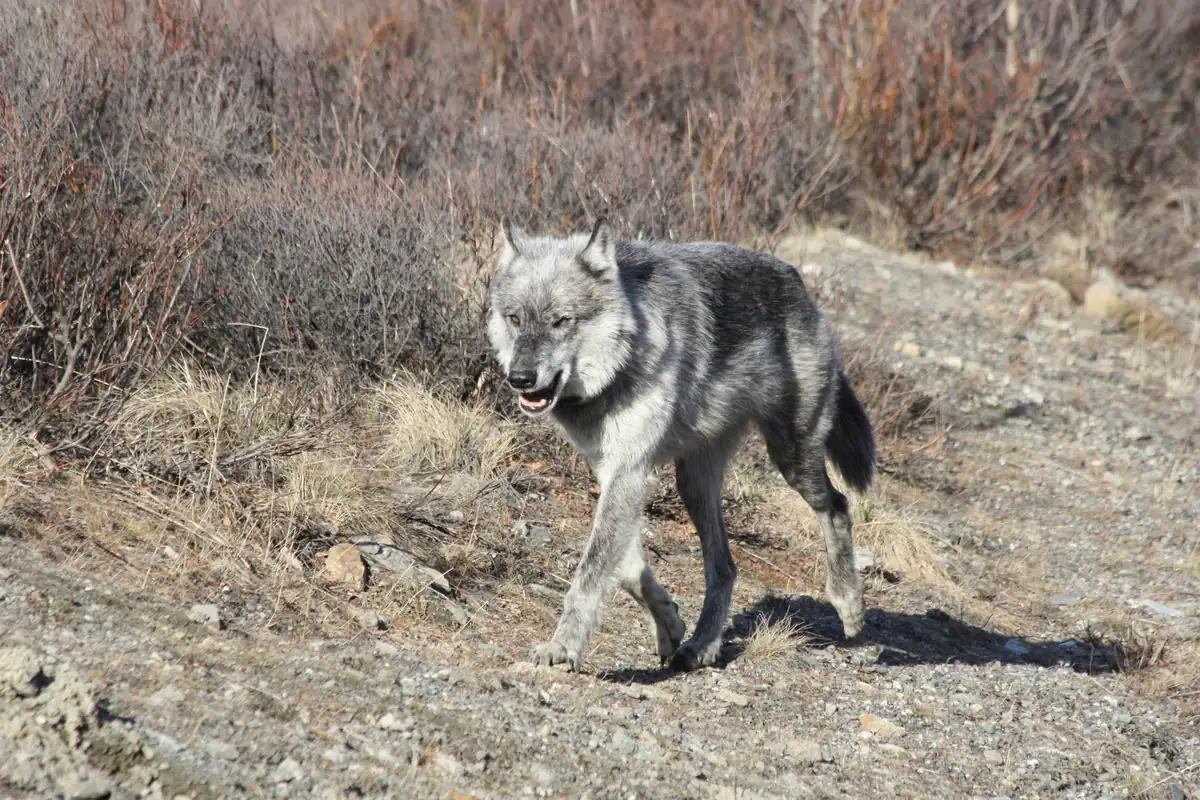
What you're hearing
When
Wolves howl year-round, most often in the evening, at night and around dawn. Howling tends to increase in winter during the breeding season and in late summer and fall, when pups are old enough to join the pack's chorus.
Where
In the lower 48 states, wild gray wolves live mainly in the western Great Lakes states (Minnesota, Wisconsin and Michigan's Upper Peninsula), the northern Rockies (Montana, Idaho and Wyoming), the Pacific Northwest (Washington, Oregon and northern California) and Colorado. Mexican gray wolves live in parts of Arizona and New Mexico. Wolves are also widespread in Alaska.
They live in forests, mountains and open country with plenty of deer, elk or moose. Outside these regions, a howl at night is almost certainly a coyote or a dog.
Why it calls
Howling is long-distance communication. A lone wolf howls to locate the rest of its pack, and a pack howls together to rally before or after a hunt and to announce its territory to neighboring packs, which helps them avoid each other.
Barks and bark-howls are alarm or warning calls, often given near pups. Whines and whimpers are close-range, friendly or submissive sounds between pack members, and growls and snarls are threats.
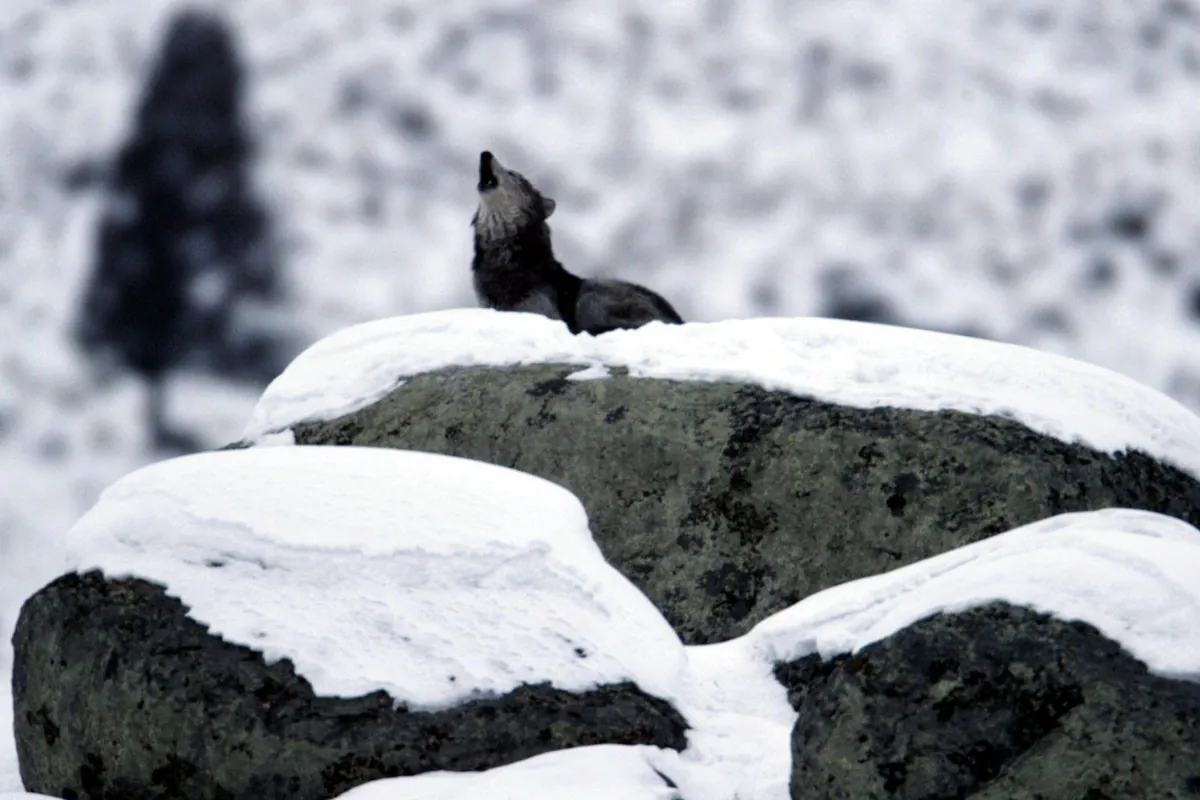

Gray wolf facts
- Size
- 4 ft. 3 in. to 6 ft. 9 in. (130-205 cm) long, nose to tail tip. Gray wolf (Smithsonian's National Zoo)
- Weight
- Males 65-175 lb. (30-80 kg), females 50-120 lb. (23-55 kg). Gray wolf (Smithsonian's National Zoo)
- Lifespan
- About 7-8 years in the wild; up to 20 in human care. Gray wolf (Smithsonian's National Zoo)
- Diet
- Carnivore that hunts mainly large hoofed prey such as moose, elk and bison, usually in packs. Canis lupus (Animal Diversity Web)
- Active
- Packs hunt and travel mostly at night. Gray wolf (Smithsonian's National Zoo)
- Calls peak
- Howling increases in the breeding season, January through April. Gray wolf (Smithsonian's National Zoo)
- Habitat
- Open tundra and forest; in North America mainly Alaska, Canada and the northern U.S. Gray wolf (Smithsonian's National Zoo)
- Conservation status
- Least Concern (IUCN Red List, 2018) Canis lupus, Grey Wolf (IUCN Red List)
Where it lives: Found in parts of the Midwest (Michigan, Wisconsin, Minnesota); most of the Southwest and southern Plains (not Texas, Oklahoma); most of the Mountain West (not Colorado, Utah, Nevada); most of the Pacific Coast (not California).
Year-roundSounds like… but isn't
- Coyote: Coyotes howl higher and break into rapid, frantic yips; wolves hold long, deep, steady notes.
- Common loon: A common loon's wail is a rising, mournful note often mistaken for a wolf, but it comes from a lake and often climbs to a higher second note.
- Great horned owl: A great horned owl gives a series of deep, soft hoots, not a single long sustained note.
Should I worry?
Wolves generally avoid people, and attacks on people are incredibly rare. Hearing wolves howl at night is not a threat. The main risk in wolf country is to dogs, because wolves are very territorial and will guard their territories against other wolves, coyotes and domestic dogs.
- Keep dogs leashed, or within sight and hearing range, and don't let them roam.
- Don't leave pets outside overnight unless they are in a sturdy kennel. If you must let a dog out after dark, turn on bright lights and make noise, or use a lit or fenced area.
- Feed pets indoors and never leave pet food outside.
- Never feed wolves, and avoid feeding deer and small mammals near your home, since they draw wolves and other predators.
If a wolf approaches or acts aggressively, make yourself look larger, use bear spray or an air horn if you have one, and back away slowly while facing it. In the very rare event of an attack, fight back.
Report wolves near homes, wolves approaching people, or any incident involving a wolf to your state wildlife agency or police. Wolf protections differ by state and region, so check with your state wildlife agency before taking action against a wolf.
Sources: ODFW Wolf Human Interactions (Oregon Department of Fish and Wildlife); Guidance for hunters and pet owners: Reducing conflict between wolves and dogs (Wisconsin Department of Natural Resources).
Questions people ask
Why do wolves howl?
To communicate over long distances. Wolves howl to find separated pack members, to rally the pack, and to tell neighboring packs that a territory is occupied. Howling is not a sign that wolves are about to attack.
Do wolves howl at the moon?
No. Wolves howl more at night and around dawn and dusk simply because that is when they are most active. There is no good evidence that the moon makes them howl.
How can I tell a wolf howl from a coyote howl?
Wolves howl lower and hold long, smooth notes; a pack chorus sounds like several deep voices harmonizing. Coyotes are higher-pitched and mix in rapid yips and barks. Where you are matters too: outside the regions with wild wolves, it is a coyote. See coyote sounds.
Do wolves bark?
Yes, but rarely compared with dogs. A wolf bark is a short, gruff alarm or warning, often given near pups or when a wolf is surprised, and may turn into a bark-howl.
Are wolves dangerous to my dog?
In wolf country, they can be. Wolves defend their territories against other canines, including domestic dogs. Keep dogs leashed or close, don't leave them outside overnight without a sturdy kennel, and don't leave pet food outdoors.
When do wolves howl the most?
Wolves howl year-round, but howling picks up during the winter and early spring breeding season, roughly January through April, according to the Smithsonian's National Zoo.
Please don't play these recordings at wild animals, especially in parks: it can stress them, and many parks prohibit it.