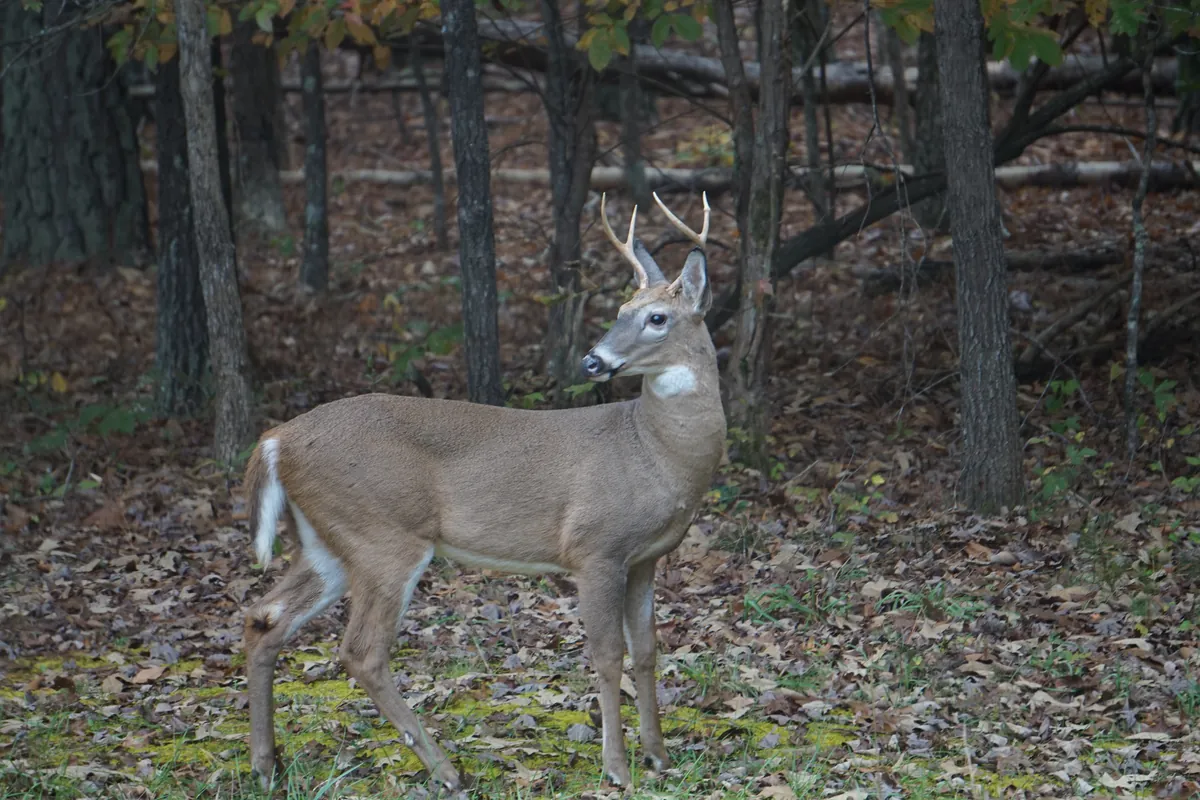
What you're hearing
When
Deer are most active around dusk and dawn and also move at night, so a snort in the dark from the edge of the yard is a classic deer sound. Alarm snorts happen all year, any time a deer is startled.
Buck grunts belong to the fall breeding season, the rut, which in much of the country runs from October into December. Fawns are born in late spring and early summer, and their bleats are most often heard from then through midsummer.
Where
White-tailed deer live across most of the lower 48 states, though they are scarce or absent in much of the far West. They live in forests, farmland, river bottoms and suburbs. In the West, mule deer and black-tailed deer make very similar snorts and grunts.
Many suburbs have deer living in wooded lots, parks and stream corridors, so it is common to hear them in backyards, along fence lines and at the edge of the woods at night.
Why it calls
The snort, or blow, is an alarm. A deer that detects something it cannot quite identify, such as a person, a dog or an unfamiliar smell, blows hard through its nose, stamps a front foot and may raise its white tail before bounding off. It warns other deer and may be meant to make a hidden predator move.
Bucks grunt during the rut while following does and confronting other bucks, and an aggressive buck may give a hissing snort-wheeze. Does make soft grunts and bleats to their fawns, and fawns bleat to call their mothers, louder and more urgently when in distress.
White-tailed deer facts
- Size
- About 6 ft. long including an 8-in. tail (Missouri figures). White-Tailed Deer (Missouri Department of Conservation)
- Weight
- Does 110-145 lb., bucks 155-195 lb. (Missouri figures). White-Tailed Deer (Missouri Department of Conservation)
- Lifespan
- Up to 15 years in the wild and 25 in captivity. White-Tailed Deer (Missouri Department of Conservation)
- Diet
- Plant eater: leaves, twigs, fruit and nuts of trees and shrubs, plus grasses, other green plants and crops. White-Tailed Deer (Missouri Department of Conservation)
- Active
- Crepuscular: most active around dawn and dusk. Odocoileus virginianus (Animal Diversity Web)
- Habitat
- Many habitats, especially edges where woods meet clearings or farm fields. White-Tailed Deer (Missouri Department of Conservation)
- Conservation status
- Least Concern (IUCN Red List, 2015) Odocoileus virginianus, White-tailed Deer (IUCN Red List)
Where it lives: Found in nearly every state in the lower 48.
Year-roundSounds like… but isn't
- Elk: An elk's alarm is a sharp, voiced bark; a deer's snort is an unvoiced rush of air, like a very loud sneeze.
- Red fox: A fox's bark is a hoarse, voiced yap, often repeated in a series; a deer's snort has no voice in it, just air.
Should I worry?
Deer themselves are rarely a danger to people. The real risk is on the road. Deer are more active in the fall breeding season than at any other time of year, and half or more of deer-vehicle collisions happen in October, November and December. Slow down and stay alert from dusk to dawn, watch for deer crossing signs, and remember that when one deer crosses, others are likely to follow. If a deer is in the road, brake, but do not swerve out of your lane: hitting another car or a tree is usually worse than hitting the deer. Always wear a seat belt.
If you hear a fawn bleating or find one lying alone in late spring or summer, leave it alone. The mother stays away except to nurse it, and a fawn may wander and cry for a short time. Do not touch it or bring children or dogs to look at it. Only a fawn that is clearly sick or injured, or that has been wandering and crying for more than a day, may need help; call your state wildlife agency or a licensed wildlife rehabilitator before doing anything.
Sources: Drivers: Stay Alert, Deer are on the Move (Virginia Department of Wildlife Resources); Deer | Keep Wildlife Wild (Wisconsin Department of Natural Resources).
Questions people ask
What does a deer sound like?
The common sound is a loud, sharp snort or blow, air forced through the nose, often repeated with foot stamps. Bucks make short, low grunts in the fall, and fawns make high, nasal bleats.
Why do deer snort at night?
Snorting is an alarm. The deer has sensed you, your dog or something else it cannot identify and is warning other deer. It usually stamps a foot and bounds away soon after.
What does a deer snort sound like?
Like a very loud, forceful sneeze or a burst of air from a hose, with no voice in it. People hearing it for the first time in the dark often think a person or large animal is right next to them.
What does a baby deer sound like?
A fawn bleats with a high, thin, nasal call, a little like a lamb or a goat kid. A loud, repeated bleat means it is distressed or calling for its mother.
Do bucks make noise during the rut?
Yes. Bucks give low, short grunts while following does, and sometimes a hissing snort-wheeze at rivals. Rattling and crashing in the brush can be two bucks sparring.
How long do deer live?
White-tailed deer can live about 15 years in the wild and up to 25 in captivity (Missouri Department of Conservation).
Please don't play these recordings at wild animals, especially in parks: it can stress them, and many parks prohibit it.