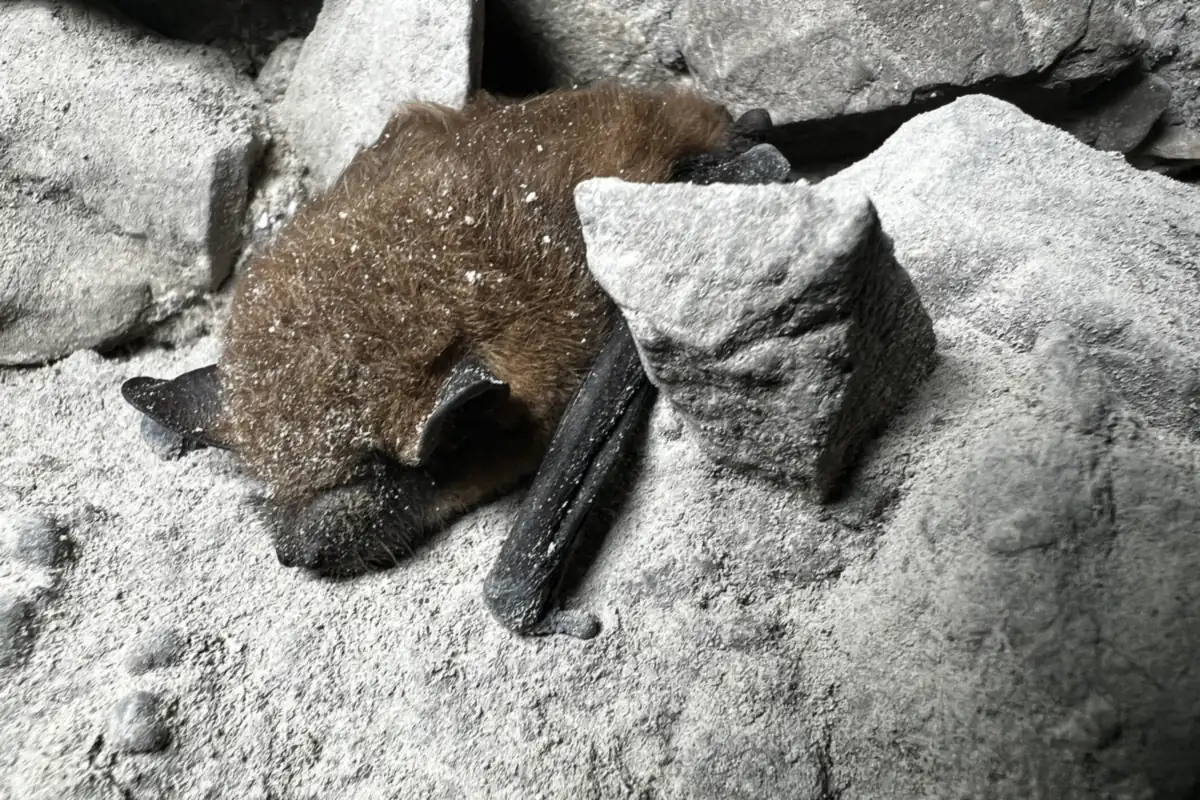
What you're hearing
When
Bats are active from spring through fall. In winter, most US bats either hibernate in caves, mines and buildings or migrate south, so they are rarely heard.
Bats roosting in a house are most noticeable at dusk, when they wake up, chatter and crawl toward the exit before flying out to feed, and again near dawn when they return. Summer is when nursery colonies of mothers and young occupy attics and walls, and the squeaking can be constant.
Where
Bats live in every state. The species most likely to move into buildings, such as big brown bats and little brown bats, roost in attics, wall voids, behind shutters and chimneys, and under roof edges. Outside, bats feed over ponds, streams, lawns and around streetlights where insects gather.
The spotted bat, a large-eared bat of the dry West, is found over canyons, cliffs and open desert and mountain country. It is one of the few US bats whose echolocation calls are low enough for many people to hear as faint, high clicks while it hunts overhead.
Why it calls
Bats find their way and catch insects by echolocation: rapid calls, mostly above the range of human hearing, whose echoes reveal obstacles and prey. You can hear echolocation only through a bat detector or a recording slowed down, which is how many recordings of bats are made.
The squeaks, chirps and chatter people do hear are mostly social calls. Bats in a roost call to each other as they jostle for space, mothers and pups call to find each other, and a bat that is grabbed, trapped or handled gives loud, harsh distress calls.
Bat facts
Bat facts vary by species; numbers here are for the big brown bat, a common house bat, and the spotted bat heard in our clip.
- Size
- Big brown bat: 4.3-5.1 in. long (110-130 mm) with a wingspan of about 13 in. (330 mm). Eptesicus fuscus (Animal Diversity Web)
- Weight
- Spotted bat: 16-20 grams (about 0.6-0.7 oz). Spotted Bat (Montana Field Guide, Montana Fish, Wildlife and Parks)
- Lifespan
- Big brown bat: up to 19 years in the wild. Eptesicus fuscus (Animal Diversity Web)
- Diet
- Big brown bat: flying insects, mainly beetles, plus moths, flies and wasps. Eptesicus fuscus (Animal Diversity Web)
- Active
- Nocturnal. Big brown bats start feeding about 20 minutes after sunset in good weather. Eptesicus fuscus (Animal Diversity Web)
- Calls peak
- Spotted bat: its low, audible clicks come while it hunts, and most foraging has been recorded between 11 p.m. and 3 a.m. Euderma maculatum (Animal Diversity Web)
- Habitat
- Roost in trees, caves, mines, rock crevices, bridges and buildings; many feed over ponds and streams. Where Bats Live (National Park Service)
Sounds like… but isn't
- Squirrel: Squirrels in an attic run, roll nuts and gnaw, mostly at dawn and dusk; bats make faint squeaks and a light scratching or fluttering, concentrated right around dusk.
- Cricket: Crickets chirp in a steady, regular rhythm all night; bat chatter is irregular, higher and squeakier, and fades once the bats fly out.
Should I worry?
Not all bats carry rabies, but bats are the animal most often reported with rabies in the US, and most people in the US who die of rabies were exposed to a rabid bat. Bat bites can be tiny, and you may not know you were bitten. Never touch a bat with bare hands. A bat that is active by day, lying on the ground, found inside a living space, unable to fly or unusually easy to approach may be sick.
If a bat is inside your home, stay calm, close interior doors to keep it in one room and move children and pets out. Do not release it until you have talked with your local health department, which will decide whether anyone may have been exposed and whether the bat should be tested. To catch it, wear leather work gloves, wait for it to land, cover it with a box or jar, slide cardboard with small air holes underneath and tape it shut. If someone was bitten or scratched, wash the wound with soap and water and get medical care right away.
To keep bats out, seal gaps around the house; bats can fit through openings as small as a quarter inch. Fall and winter are the best times to bat-proof. Between May and August, sealing openings can trap young bats inside. Your state wildlife agency lists licensed wildlife control operators who can do exclusion work.
Sources: Preventing Rabies from Bats (Centers for Disease Control and Prevention); What do I do if I find a bat in my house? (Connecticut Department of Public Health).
Questions people ask
Can you hear bats?
Usually not their echolocation, which is mostly too high for human hearing. You can hear their social squeaks and chatter, especially from a roost, and in parts of the West, the spotted bat's echolocation clicks are audible to many people.
What do bats in the attic or walls sound like?
Faint, high squeaking and chattering, plus light scratching, rustling or fluttering, loudest around dusk when the bats get ready to fly out. Summer nursery colonies with young can be noisy for weeks.
Why do bats squeak?
Audible squeaks are mainly social calls between roostmates and between mothers and pups, or distress calls from a bat that is trapped or handled.
There is a bat in my house. What should I do?
Do not touch it or let it go yet. Close it in one room, keep people and pets out, and call your local health department, which will tell you whether it needs to be captured and tested for rabies. If you capture it, wear leather gloves and use a container and cardboard.
When is the best time to get bats out of an attic?
Fall or winter, after the bats have left for the season. Sealing entry points between May and August can trap flightless young inside.
What kind of bat lives in houses?
In much of North America it is often the big brown bat, which lives in cities, towns and farm country and roosts in barns, churches and houses, often inside walls or boxed-in eaves. See Animal Diversity Web.
Please don't play these recordings at wild animals, especially in parks: it can stress them, and many parks prohibit it.