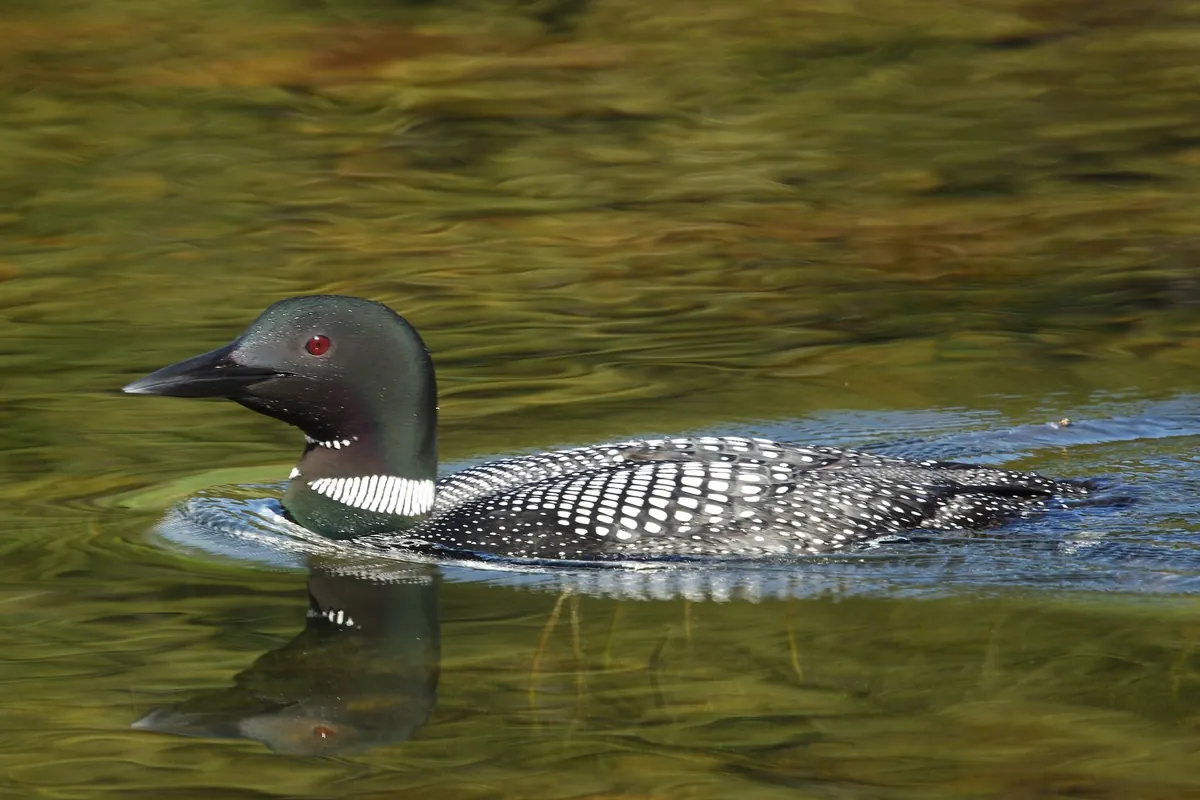
What you're hearing
When
Loons are most vocal on their nesting lakes from spring through midsummer, when pairs claim territories, nest and raise chicks. They call during the day, but the wail, yodel and tremolo carry best and are heard most often at dusk, at night and around dawn.
In fall and winter, loons move to the coasts and large open lakes and reservoirs, where they are much quieter.
Where
Common loons nest on clear lakes across Canada, Alaska and the northern edge of the lower 48, including Maine, New Hampshire, Vermont, the Adirondacks of New York, northern Michigan, Wisconsin and Minnesota, and parts of the northern Rockies and Pacific Northwest.
In winter they live along the Atlantic, Pacific and Gulf coasts and on some large inland lakes and reservoirs. If you are at a lake cabin in the North Woods in summer and hear an eerie call over the water at night, it is almost certainly a loon.
Why it calls
Each call has its own job. The wail is a long-distance contact call that mates use to find each other. The tremolo, the "crazy laugh," signals alarm or excitement and is the call loons give in flight. The yodel is given only by males to defend a territory, and each male's yodel is distinctive. The hoot is a soft call used up close between mates and their chicks.
If a loon starts calling as a boat approaches, it is reacting to the disturbance.
Common loon facts
- Size
- 26 to 35.8 inches (66 to 91 cm) long, with a wingspan of 40.9 to 51.6 inches (104 to 131 cm). Common loon (U.S. Fish and Wildlife Service)
- Weight
- 5.5 to 13.4 pounds (2.5 to 6.1 kg). Common loon (U.S. Fish and Wildlife Service)
- Lifespan
- Long-lived: the oldest known common loon reached 25 years, and USGS notes loons may live 30 or more. Common Loon Questions (USGS Upper Midwest Environmental Sciences Center)
- Diet
- Mainly fish, plus aquatic invertebrates such as crayfish and aquatic insects. Common Loon Questions (USGS Upper Midwest Environmental Sciences Center)
- Habitat
- Summers on northern lakes in Alaska, Canada and the northern lower 48; winters on coastal ocean waters. Common loon (U.S. Fish and Wildlife Service)
- Conservation status
- Least Concern (IUCN Red List, 2018) Gavia immer (IUCN Red List)
Where it lives: Found in most of the Northeast (not Pennsylvania); most of the Mid-Atlantic and Southeast (not District of Columbia, West Virginia, Kentucky, Tennessee, Alabama, Mississippi, Arkansas); parts of the Midwest (Michigan, Wisconsin, Minnesota); parts of the Southwest and southern Plains (Texas); most of the Mountain West (not Colorado, Utah, Nevada); all of the Pacific Coast. Summer (breeding) only: Idaho, Maine, Michigan, Minnesota, Montana, New Hampshire, New York, Vermont, Washington, Wisconsin, Wyoming. Winter only: 17 states.
Summer (breeding)WinterSounds like… but isn't
- Gray wolf: A wolf howl comes from land and often drops in pitch at the end, while a loon's wail comes from open water and often rises and breaks between two or three notes.
- Coyote: Coyotes break their howls into yips and barks, often in a group; a loon's wail is smooth and clear, and its tremolo sounds more like laughter than yipping.
- Barred owl: Barred owls hoot and cackle from the trees in a rhythmic pattern, while loon calls are long, pure tones from the water.
Should I worry?
No. Loon calls are harmless, and loons have no interest in people on shore.
The loons are the ones at risk from people. Approaching too closely can cause adults to leave their nests, which chills the eggs and can cause the nest to fail, and boats can run over young chicks, which cannot dive well. Minnesota's wildlife agency advises that if you approach a loon and it starts calling, or it rises up out of the water and slaps its wings, you are too close and should move away.
Common loons are protected under the federal Migratory Bird Treaty Act, and states such as Minnesota prohibit harassing wildlife. Report harassment of loons to your state wildlife agency.
Sources: Be Loon Aware! (Minnesota Department of Natural Resources); Migratory Bird Treaty Act of 1918 (U.S. Fish & Wildlife Service).
Questions people ask
What does a loon sound like?
Common loons have four main calls: a long, haunting wail; a quavering, laughing tremolo; a loud, rising yodel given only by males; and a soft hoot used at close range.
Why do loons call at night?
Loons call to keep in touch with their mates and to defend their territory, and their calls carry farther in the still night air. Wails, yodels and tremolos are especially common after dark during the nesting season.
What bird sounds like a wolf howling on a lake?
A common loon's wail. It is often mistaken for a wolf, but it comes from open water and has a clearer, more musical tone.
What does it mean when a loon laughs?
The laughing call is the tremolo. It usually means the loon is alarmed or excited, for example when a boat, predator or another loon comes too close. It is also the call loons give in flight.
Where can you hear loons in the United States?
In summer, on northern lakes in states such as Maine, New Hampshire, Vermont, New York, Michigan, Wisconsin and Minnesota, plus Alaska and parts of the Northwest. In winter they live along the coasts and are mostly silent.
How big is a common loon?
Big for a water bird: 26 to about 36 inches long and 5.5 to 13.4 pounds, with a wingspan of about 41 to 52 inches, per the U.S. Fish and Wildlife Service.
How long do loons live?
Common loons are long-lived. The oldest known loon reached 25 years, and USGS says they may live 30 years or more.
Please don't play these recordings at wild animals, especially in parks: it can stress them, and many parks prohibit it.