What you're hearing
When
Great horned owls hoot year-round, most often in the early evening and again before dawn. Calling peaks in fall and winter, when pairs court and set up territories. In North Carolina, for example, the state wildlife agency notes that courtship calling starts in October and peaks in November and December.
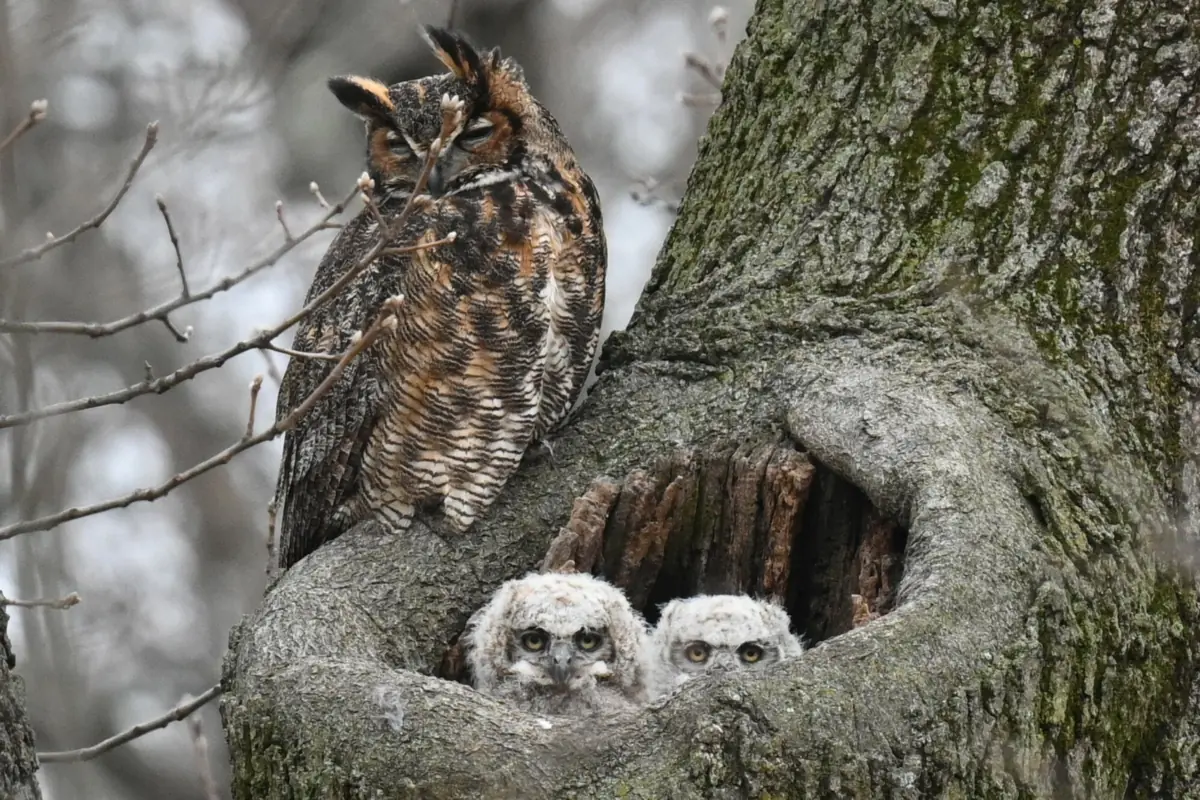
They are among the earliest nesting birds in North America, laying eggs in winter (as early as December in Florida). Hooting slows down once eggs are in the nest. In late spring and summer, the loud night-time screeching comes from young owls that have left the nest and are begging for food.
Where
Great horned owls live in nearly every part of the United States: forests, farmland, deserts, prairies, city parks and suburbs. If you hear a deep hoot in a city neighborhood, this is the most likely owl.
They often nest high in trees, usually in old stick nests built by hawks, crows or squirrels, and sometimes on ledges or buildings.
Why it calls
The deep hoot is a territorial call that tells other owls the area is taken. Mated pairs often hoot back and forth in a duet; the female's voice is noticeably higher than the male's even though she is the larger bird.
Young owls out of the nest give a raspy, screechy begging call, repeated over and over through the night, so their parents can find and feed them. Adults that feel threatened may bark, hiss or snap their bills. Compare other owls on the owl sounds page.
Great horned owl facts
- Size
- 20-24 in. long with a 40-56 in. wingspan. Great Horned Owl (Missouri Department of Conservation)
- Weight
- About 3.1 lb.; females are larger than males. Great Horned Owl (Tennessee Wildlife Resources Agency)
- Lifespan
- Can live nearly 30 years, but 13 is old for most wild birds. Great Horned Owl (Missouri Department of Conservation)
- Diet
- The most varied diet of any North American raptor: rodents, rabbits, birds including crows, snakes, insects, even skunks. Great Horned Owl (Missouri Department of Conservation)
- Active
- Nocturnal, hunting from a high perch; occasionally hunts in daylight. Great Horned Owl (Missouri Department of Conservation)
- Calls peak
- December and January, when pairs are setting up territories ahead of nesting. Great Horned Owl (Tennessee Wildlife Resources Agency)
- Habitat
- Almost anywhere: forest, desert, grassland, farmland, and wooded parks and suburbs. Great Horned Owl (Tennessee Wildlife Resources Agency)
- Conservation status
- Least Concern (IUCN Red List, 2018) Bubo virginianus, Great Horned Owl (IUCN Red List)
Where it lives: Found in nearly every state in the lower 48.
Year-roundSounds like… but isn't
- Barred owl: A barred owl's hoot is louder and more rhythmic ("who cooks for you") and often breaks into cackles, which great horned owls do not do.
- Barn owl: A barn owl's scream is a single long, harsh hiss, often given in flight; a young great horned owl's begging screech is shorter and repeated from one spot.
- Screech owl: Screech owls are small and give whistled whinnies or trills, not deep hoots.
Which owl is that? Compare all four owls →
Should I worry?
Hearing a great horned owl is not a problem in itself. The calls are territorial or between mates, and the owl is mostly hunting rodents, rabbits and other small animals.
Small pets are a real but uncommon concern. State wildlife agencies note that great horned owls have rarely taken unattended small cats and puppies, and that owls are unlikely to carry off a pet. If you know owls hunt your yard, keep small dogs leashed and supervised outdoors, especially at night, dusk and dawn, and keep cats indoors at night. Free-roaming chickens and ducks are much more vulnerable: use a fully enclosed run with overhead cover.
Parent owls may swoop at people or pets near a nest or young. Give nesting owls space and avoid the area for a few weeks if possible. Young owls are often on the ground before they can fly well while their parents watch nearby; leave them alone unless they are visibly injured.
Owls, their young and their active nests are protected under the federal Migratory Bird Treaty Act and state law. If you find an injured owl, contact a licensed wildlife rehabilitator or your state wildlife agency.
Sources: Great Horned Owl (North Carolina Wildlife Resources Commission); Great Horned Owl (Florida Fish and Wildlife Conservation Commission); Living with wildlife: Owls (Washington Department of Fish & Wildlife).
Questions people ask
What does a great horned owl sound like?
A deep, soft hoot in a stuttering rhythm of about four or five notes, often written as "hoo, h'HOO, hoo, hoo." Pairs frequently answer each other, with the female's hoot pitched higher than the male's.
Why do I hear two owls hooting back and forth?
That is usually a mated pair duetting, which is most common in fall and winter as they court and claim a nesting territory.
What is screeching in the trees on summer nights?
In much of the US, a repeated harsh screech from the treetops in late spring or summer is often a young great horned owl begging its parents for food. Barn owls and young barred owls make similar sounds.
Will a great horned owl attack my cat or small dog?
It is rare, but it has happened with small cats and puppies left outside unattended. Supervising small pets outdoors at night, dusk and dawn, and keeping cats in at night, removes most of the risk.
What does it mean when you hear an owl at night?
It means an owl is living or hunting nearby and is calling to claim its territory or keep in touch with its mate. Superstitions aside, it has no other meaning.
How big is a great horned owl?
Great horned owls are 20 to 24 inches long with a wingspan of 40 to 56 inches (Missouri Department of Conservation), yet they weigh only about 3 pounds. Females are larger than males.
When do great horned owls hoot the most?
In early winter. Hooting is easiest to hear in December and January, when pairs are claiming territories before they nest (Tennessee Wildlife Resources Agency).
Please don't play these recordings at wild animals, especially in parks: it can stress them, and many parks prohibit it.