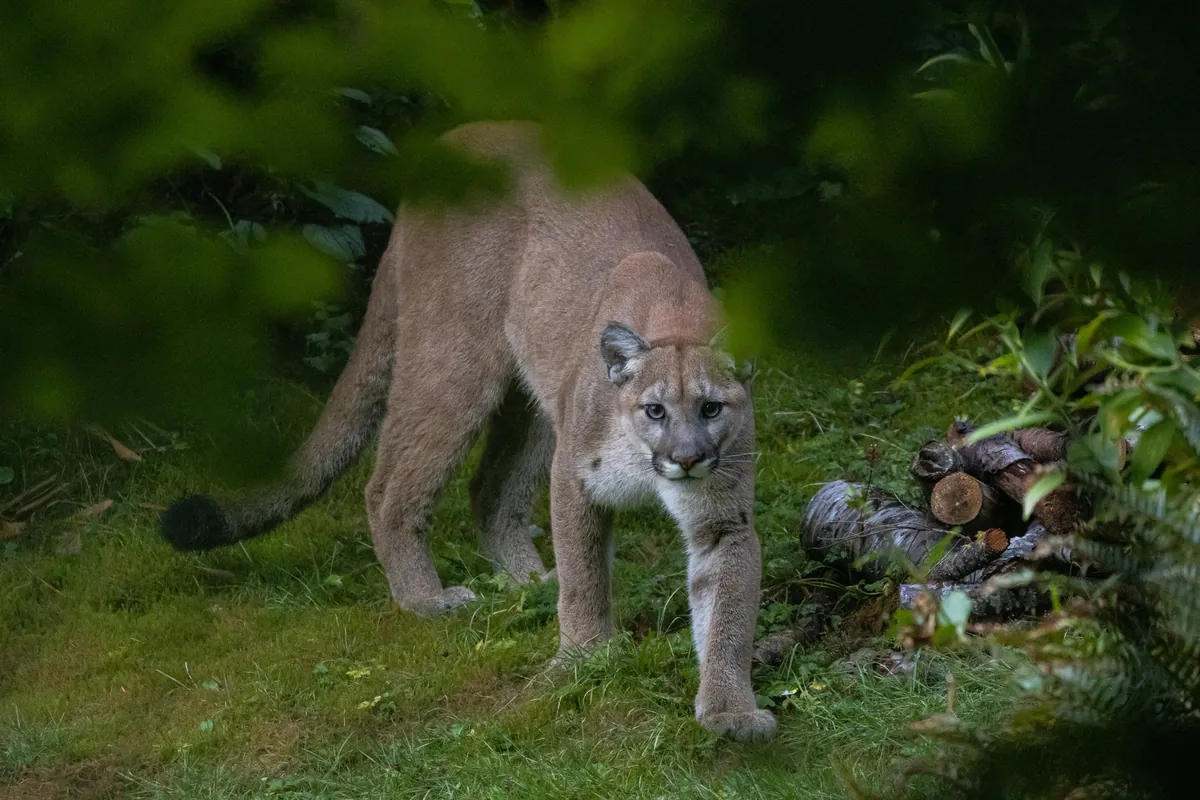
What you're hearing
When
Mountain lions can breed in any month, so screaming can be heard year-round, mostly at night and around dusk and dawn. Calls tend to come in bouts over several nights while a female is in heat, then stop.
Chirps and whistles are heard mainly when a mother is with kittens, which can also be at any time of year.
Where
Mountain lions live mainly in the western United States, from the Rockies and Great Basin to the Pacific coast and the Southwest, plus western Texas and the Black Hills. A small population, the Florida panther, lives in southern Florida. Young males occasionally wander far into the Midwest and beyond.
They favor rugged, wooded or brushy country with plenty of deer, but in the West they regularly pass through foothill subdivisions, canyons and the edges of towns, especially where deer are common.
Why it calls
The scream is mainly a mating call. Females in heat scream and caterwaul to advertise to males, and males may answer. It is not a hunting call; lions hunt silently.
Mothers and kittens keep in touch with chirps, peeps and whistles that sound more like a bird than a big cat. Hisses, growls and snarls are defensive sounds given at close range, for example by a lion guarding a kill or kittens.
Mountain lion facts
- Size
- Including the tail, males 7-8 ft. and females 5-7 ft. (California figures). Mountain Lions in California (California Department of Fish and Wildlife)
- Weight
- Males up to 170 lb., females up to 120 lb. (California figures). Mountain Lions in California (California Department of Fish and Wildlife)
- Lifespan
- Can reach 18-20 years in the wild, slightly longer in captivity. Puma concolor (Animal Diversity Web)
- Diet
- Mostly deer; also elk, porcupines, small mammals, and sometimes livestock and pets. Living with Mountain Lions (Colorado Parks and Wildlife)
- Active
- Most active from dusk to dawn, though they also travel and hunt by day. Living with Mountain Lions (Colorado Parks and Wildlife)
- Habitat
- Mountain conifer forest, tropical lowland forest, grassland, dry brush country and swamps. Puma concolor (Animal Diversity Web)
- Conservation status
- Least Concern (IUCN Red List, 2014) Puma concolor, Puma (IUCN Red List)
Where it lives: Found in parts of the Mid-Atlantic and Southeast (Florida); parts of the Midwest (North Dakota, South Dakota, Nebraska); most of the Southwest and southern Plains (not Oklahoma); all of the Mountain West; all of the Pacific Coast.
Year-roundSounds like… but isn't
- Bobcat: Bobcat and mountain lion screams are hard to tell apart by ear; a bobcat's yowl is usually higher, shorter and more like an amplified housecat, and bobcats live in far more of the country.
- Red fox: A fox gives one short, hoarse scream every few seconds, while a mountain lion's scream is longer, louder and more drawn out.
- Barn owl: A barn owl's shriek is a raspy hiss lasting a second or two, often from a moving bird overhead, while a lion's scream is a full-throated wail from the ground.
Should I worry?
Mountain lion attacks on people are rare; Colorado Parks and Wildlife notes fewer than a dozen deaths in North America in more than 100 years. A scream means a lion is in the area looking for a mate, not that it is hunting you.
Around the home:
- Bring pets in at night, and keep livestock and outdoor pets in sturdy, covered enclosures overnight.
- Keep pets leashed on walks and don't leave pet food outside.
- Don't feed deer or other wildlife. Deer are a lion's main prey, and attracting them can attract lions.
- Clear dense brush and tall grass near the house that could give a lion cover.
- Keep children close, especially at dawn and dusk.
If you see a mountain lion, never approach it and give it an escape route. Do not run, crouch or turn your back. Stay calm, face it, speak firmly, raise your arms or open your jacket to look bigger, and pick up small children and pets. Back away slowly. If a lion attacks, fight back with rocks, sticks, tools or bare hands.
Report an encounter, a lion acting boldly around people, or the loss of a pet or livestock to your state wildlife agency. Call 911 in an emergency.
Sources: Living with Mountain Lions (Colorado Parks and Wildlife); Human-Wildlife Conflicts: Mountain Lions (California Department of Fish and Wildlife).
Questions people ask
Why do mountain lions scream?
Mostly to find a mate. A female in heat screams and caterwauls to let males know, and the calling can go on over several nights. Mountain lions do not scream while hunting.
Do mountain lions roar?
No. Cougars cannot roar like lions or tigers. Their range of sounds is closer to a very large housecat: screams, purrs, hisses, growls, and bird-like chirps and whistles.
Is a cougar scream the same as a mountain lion scream?
Yes. Cougar, mountain lion, puma and panther are all names for the same animal, Puma concolor. In Florida it is called the Florida panther.
Can you tell a mountain lion from a bobcat by its scream?
Not reliably. Both make loud, wavering screams. A bobcat's tends to be higher and shorter, and bobcats are far more widespread, so outside the West a cat scream is much more likely to be a bobcat or a red fox. Compare them on our animal screams page.
I heard a mountain lion scream near my house. Should I be worried?
It means a lion is in the area, which is not unusual near wild land in the West. Attacks on people are rare. Bring pets and livestock into secure, covered shelter at night, don't feed deer, keep children close at dawn and dusk, and report repeated sightings near homes to your state wildlife agency.
How big is a mountain lion?
Adult males in California can be 7 to 8 feet long including the tail and weigh up to 170 pounds; females are smaller, up to 120 pounds. See California Department of Fish and Wildlife.
Please don't play these recordings at wild animals, especially in parks: it can stress them, and many parks prohibit it.