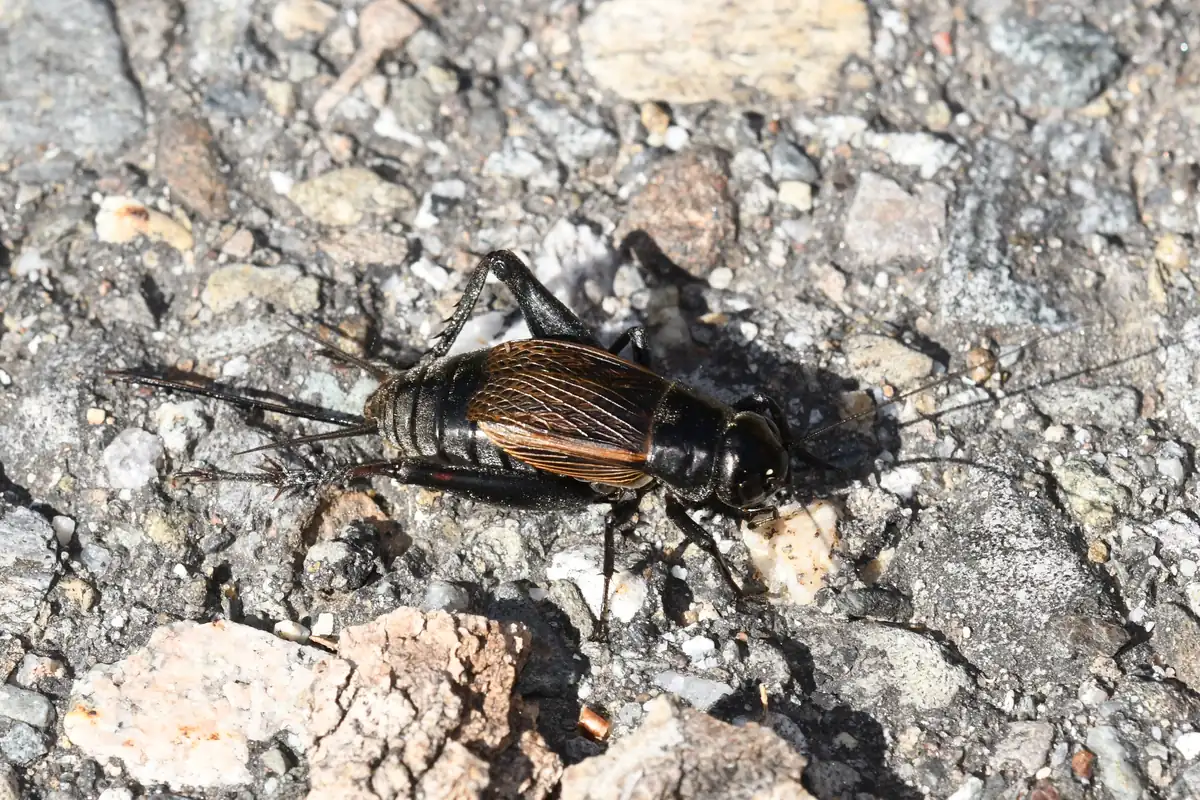
What you're hearing
When
Crickets call mainly from late summer into fall, and they are most noticeable from dusk through the night. Field crickets can also chirp during the day. Calling slows down as nights get cooler and stops after hard frosts.
A cricket that has come indoors may chirp at any hour, and often in fall when outdoor crickets move toward buildings.
Where
Field crickets live across the United States in lawns, fields, gardens and the cracks around foundations, sidewalks and window wells. Tree crickets, including the snowy tree cricket, sing from shrubs, vines and low tree branches in yards and along woodland edges.
Crickets come into homes through open doors and windows and through gaps in foundations. Outdoor lights draw them close to the house at night.
Why it calls
Only males chirp. They rub their wings together, a file on one wing scraping a ridge on the other, to make a call that attracts females and tells other males the spot is taken. Different species have different chirp patterns.
Snowy tree crickets often chirp in unison across a yard, producing a steady pulsing rhythm. Their chirp rate rises on warm nights and slows when it is cool, which is why they are sometimes called thermometer crickets.
Cricket facts
Field crickets (Gryllus) and the snowy tree cricket (Oecanthus fultoni) differ; each fact says which.
- Size
- Field crickets: 12 to 30 mm (about ½ to 1¼ in) depending on species. Snowy tree crickets: 15 to 18 mm. Crickets (Utah State University Extension)
- Lifespan
- Usually one generation a year: adults mate in late summer, and eggs laid in fall hatch the next spring. Crickets (Utah State University Extension)
- Diet
- Field crickets are omnivores, eating leaves, fruit, grain, other insects and more. Field Crickets (Missouri Department of Conservation)
- Active
- Field crickets are nocturnal; their chirping is a classic nighttime sound. Field Crickets (Missouri Department of Conservation)
- Calls peak
- Field crickets are active June to September; snowy tree crickets July to October. Crickets (Utah State University Extension)
- Habitat
- Field crickets: lawns, fields, pastures, prairies, roadsides and woods; they sometimes wander indoors. Field Crickets (Missouri Department of Conservation)
Sounds like… but isn't
- Common true katydid: Katydids give a harsh, raspy two- or three-part "katy-did" from high in the trees, not a clean musical chirp.
- Cicada: Cicadas make a loud continuous buzz mostly in daytime heat, while crickets chirp in separate notes, mostly at night.
- Spring peeper: Spring peepers give single rising whistles from wet areas in early spring, a season when crickets are not yet calling.
Should I worry?
Crickets calling outdoors need no action. Indoors they are mostly a noise problem: in northern states such as Minnesota crickets have one generation a year and rarely reproduce inside a house. House crickets can feed on fabrics such as silk and wool and may damage them if they become numerous.
To keep them out, seal cracks and gaps around doors, ground-level windows and the foundation, and reduce outdoor lighting near the house, since lights attract field and house crickets. Sticky traps placed where you hear or see crickets will catch ones already inside.
Sources: Crickets (University of Minnesota Extension).
Questions people ask
How do I find a cricket in my house?
Turn off nearby noise and walk slowly toward the chirping; crickets usually stop when you get close, so wait quietly until it starts again. Check behind appliances, in baseboard gaps, under furniture, in basements and near doors. Sticky traps set in those spots will catch one you cannot find.
Why do crickets chirp at night?
Male crickets call to attract females and warn off other males, and the dark hours are when they are most active and least likely to be caught by daytime predators.
Why does a cricket stop chirping when I get close?
Crickets sense vibrations and movement, and a calling male goes quiet when something approaches, which makes them hard to locate by ear.
Can crickets tell the temperature?
Cricket chirp rates speed up in warm weather and slow in cool weather, and the snowy tree cricket's steady rhythm is especially closely tied to temperature. That is the origin of the name "thermometer cricket."
Are crickets in the house a problem?
Usually not a serious one. They rarely reproduce indoors, but house crickets can chew silk and wool when numerous. Sealing entry points and dimming outdoor lights keeps most of them out.
How long do crickets live?
Most outdoor crickets live less than a year. They typically have one generation per year: eggs laid in the soil in fall hatch the next spring, the nymphs grow through summer, and adults mate in late summer. Source: Utah State University Extension.
Please don't play these recordings at wild animals, especially in parks: it can stress them, and many parks prohibit it.