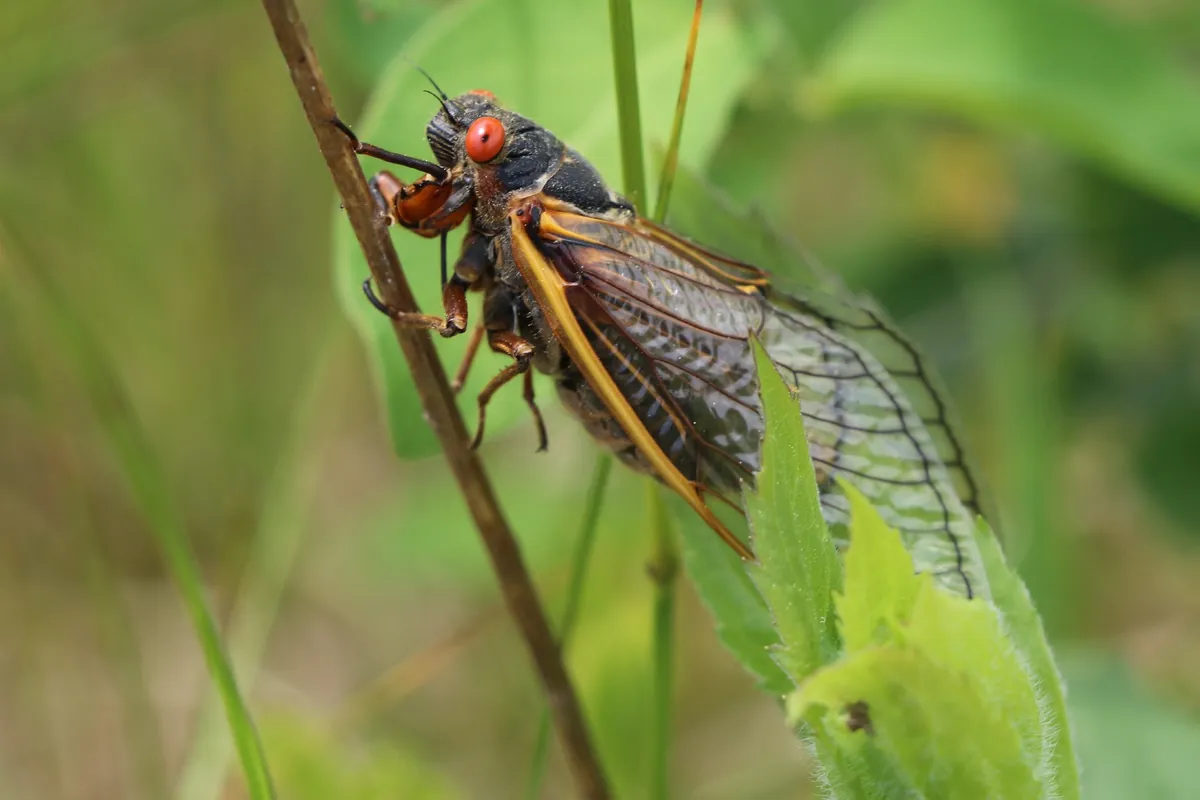
What you're hearing
When
Annual cicadas, often called dog-day cicadas, come out every summer. You hear them most from midsummer into early fall, loudest in the heat of the day, and some species keep singing into dusk. They usually go quiet after dark, which is a good clue: a loud insect sound in the middle of the night is more likely a katydid or cricket.
Periodical cicadas are different. They emerge in huge numbers only every 13 or 17 years, in late spring and early summer, and their chorus can go on all day for several weeks before the adults die off.
Where
Cicadas live wherever there are trees, which includes most suburbs, city parks and older neighborhoods with mature shade trees. The nymphs spend years underground feeding on tree roots, then climb out, shed their skins on trunks, fences and walls, and sing from the branches.
Periodical cicadas occur only in the eastern half of the United States, and each emergence covers particular areas, so one town can be overwhelmed while the next county is quiet.
Why it calls
Only male cicadas sing. They make the sound by rapidly vibrating thin membranes on the sides of the abdomen, and the song is a mating call to attract females, which are silent. Males of the same species often sing together, which is why the sound seems to rise and fall in waves across a neighborhood.
A cicada that buzzes loudly when you pick it up is giving a startled alarm call, not a threat.
Cicada facts
Annual (dog-day) cicadas and periodical cicadas differ; each fact says which.
- Size
- Annual cicadas: about 1½ to 2½ inches long. Periodical cicadas: smaller, about ¾ to 1½ inches. Cicadas (University of Illinois Extension)
- Lifespan
- Periodical: 13 or 17 years underground, then 2 to 6 weeks as adults. Dog-day: 2 to 5 years as nymphs. Cicadas in Maryland (University of Maryland Extension)
- Diet
- Plant sap: adults suck xylem fluid from trees and shrubs; nymphs feed on root sap underground. Cicadas in Maryland (University of Maryland Extension)
- Active
- Daytime: males sing during the day to attract females. Cicadas (University of Illinois Extension)
- Calls peak
- Periodical broods: late spring, about April to mid-June. Dog-day cicadas: June through August. Cicadas in Maryland (University of Maryland Extension)
- Habitat
- Annual cicadas: wooded areas, parks and forest edges, since eggs go into twigs and nymphs feed on tree roots. Annual Cicadas (Missouri Department of Conservation)
Sounds like… but isn't
- Common true katydid: Katydids rasp in short, regular pulses ("katy-did") at night, while cicadas give a long continuous buzz or whine mostly in daytime.
- Cricket: Crickets make clear, musical chirps or trills, much softer and more rhythmic than a cicada's harsh, rising drone.
Should I worry?
No. Cicadas are not poisonous and cannot bite or sting people; the pointed organ on a female is only used to lay eggs in twigs. The noise is the main nuisance, and it ends on its own once the adults die off.
The one real concern is young trees during a periodical cicada emergence. Females cut slits into small twigs to lay eggs, which can cause branch tips to brown and break ("flagging"). Newly planted trees can be covered with fine netting with openings of about a quarter to three-eighths of an inch, secured around the trunk; ordinary bird netting has holes too large to keep cicadas out. Large, established trees may show a lot of flagging but rarely suffer severe damage, and control is not recommended for them.
Dogs and other animals readily eat cicadas. Extension specialists advise discouraging pets from eating large numbers, which can cause an upset stomach.
Sources: Periodical Cicada (Virginia Cooperative Extension, Virginia Tech); Cicadas in Maryland (University of Maryland Extension).
Questions people ask
Why are cicadas so loud?
Male cicadas have a specialized sound organ: thin membranes on the sides of the abdomen that they vibrate very quickly, with the mostly hollow body helping the sound carry. Many males sing at once from the same trees, so the chorus is louder than any single insect.
What does a cicada sound like?
Annual cicadas make a loud, electric buzz or whine that often rises, holds and then fades, a bit like a power line or a saw. Periodical cicadas produce a more continuous roar or hum when thousands sing together.
Do cicadas sing at night?
Mostly not. Cicadas are daytime singers and some keep going into dusk. A loud, rhythmic insect noise after dark is usually katydids or crickets.
Do cicadas bite or sting?
No. Cicadas cannot bite or sting and are not poisonous. They may buzz loudly if you handle them, but they are harmless to people.
What is the difference between annual and periodical cicadas?
Annual, or dog-day, cicadas emerge in modest numbers every summer. Periodical cicadas emerge all at once in huge numbers every 13 or 17 years, in late spring and early summer in the eastern United States.
Will cicadas hurt my trees?
Established trees usually tolerate them. Young or newly planted trees can lose twig tips when females lay eggs during a periodical emergence, so cover them with fine netting during that period.
How long do cicadas live?
Periodical cicadas spend 13 or 17 years underground as nymphs, then live only about 2 to 6 weeks as adults. Annual (dog-day) cicadas take 2 to 5 years to develop, and because their generations overlap, some emerge every summer. Source: University of Maryland Extension.
Please don't play these recordings at wild animals, especially in parks: it can stress them, and many parks prohibit it.