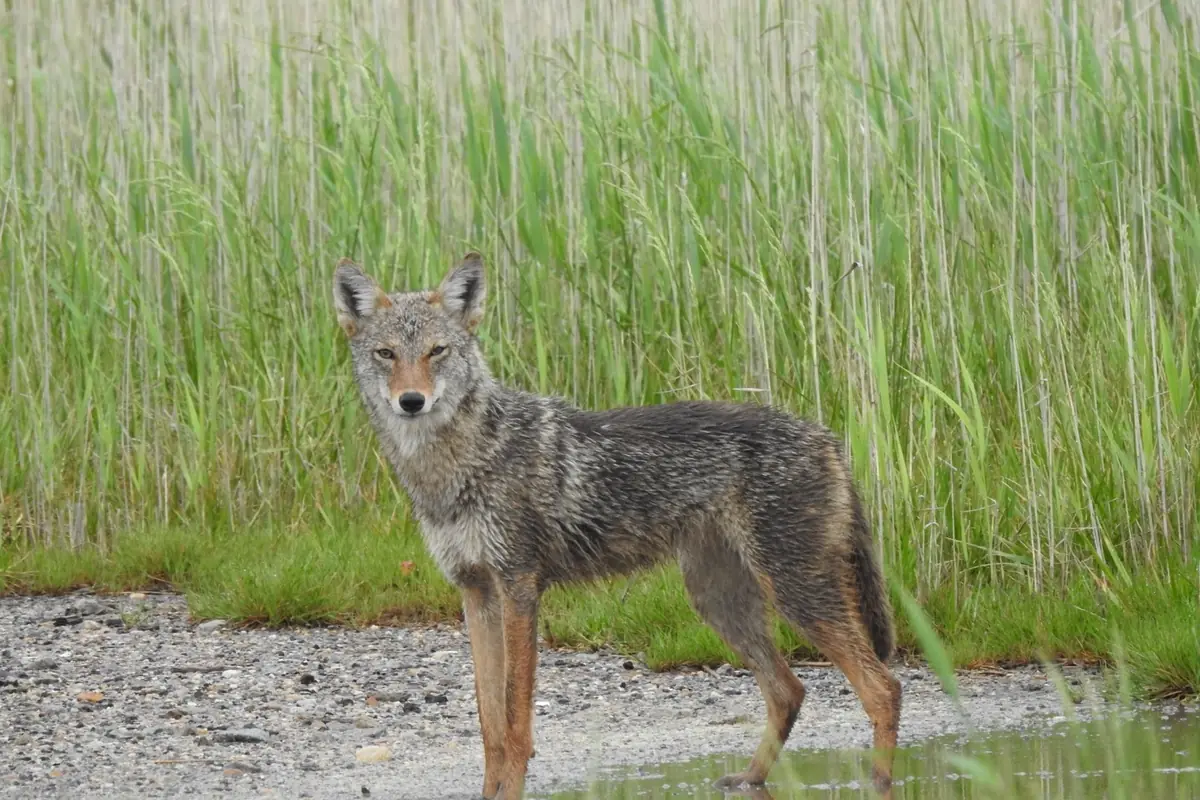
What you're hearing
When
Coyotes call year-round, mostly from dusk through the night and again around dawn. A chorus often lasts less than a minute and may repeat later in the night.
Many people notice more calling in winter, around the breeding season (roughly January through March), and again in late summer and fall, when the year's pups are old enough to join in. Sirens, train horns and other coyotes calling in the distance often set off a chorus.
Where
Coyotes live in every state of the lower 48 and in Alaska, in farmland, desert, forest, suburbs and the middle of large cities. They have adapted well to living near people, so hearing them from a backyard, golf course, park or greenbelt is normal.
Sound carries a long way at night, especially across open ground or water, so a chorus that sounds close may be some distance off.
Why it calls
The group yip-howl is how a family group announces itself and keeps in touch: it marks the territory for neighboring coyotes and helps scattered family members find each other. Coyotes often break into it when they reunite at dusk.
A lone, drawn-out howl is usually one coyote trying to locate others. Sharp barks and bark-howls are warnings, often given when a coyote is startled or when a person or dog comes near a den or pups. Coyotes also whine, growl and huff at close range, but those sounds rarely carry far.
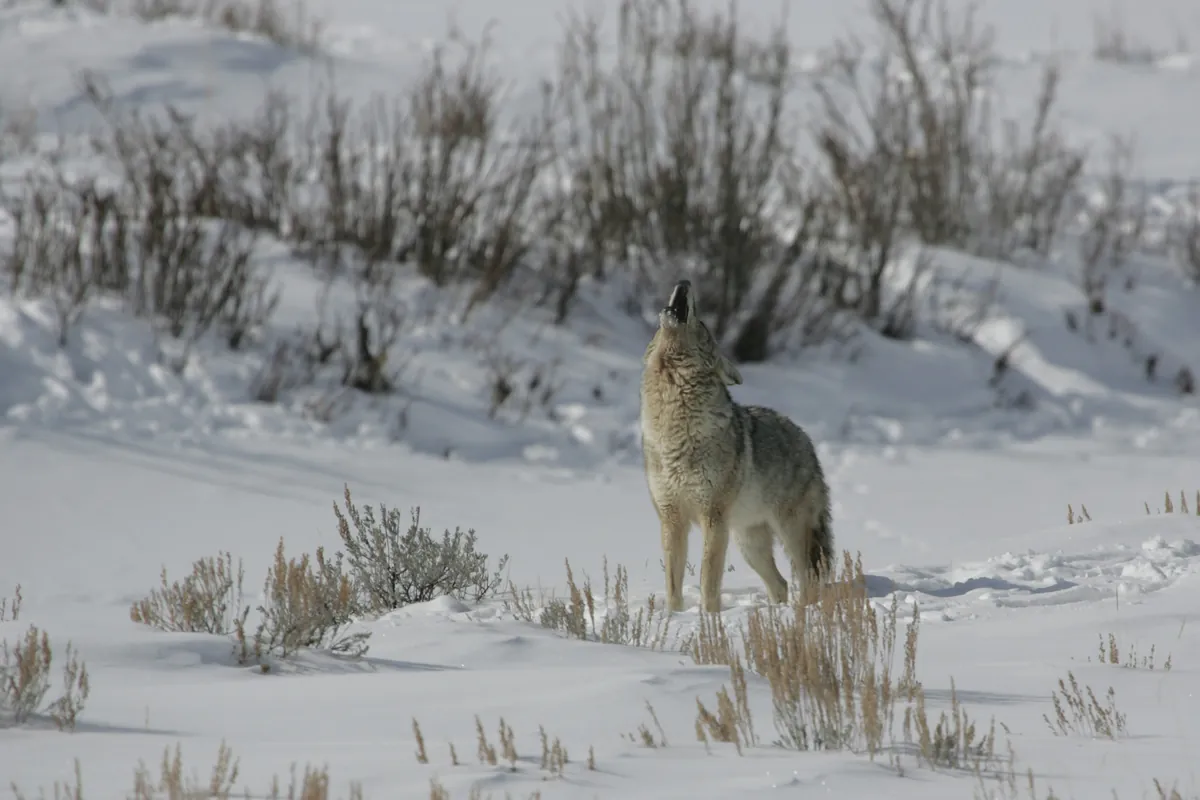

Coyote facts
- Size
- Head and body 29.5-39.4 in. (75-100 cm), plus a black-tipped tail about half that long. Canis latrans (Animal Diversity Web)
- Weight
- 15-46 lb. (7-21 kg). Canis latrans (Animal Diversity Web)
- Lifespan
- Up to about 10 years in the wild; 18 years recorded in captivity. Canis latrans (Animal Diversity Web)
- Diet
- Mainly a meat eater: about 90% of the diet is mammals, mostly small ones such as rodents and rabbits. Canis latrans (Animal Diversity Web)
- Active
- Active day and night, but busiest in the evening and early morning. Coyote (Wind Cave National Park, NPS)
- Calls peak
- Heard year-round, most often around dusk and dawn. Coyote (Connecticut DEEP)
- Habitat
- Very adaptable: forest, grassland, desert and swamp, plus farmland, suburbs and cities. Canis latrans (Animal Diversity Web)
- Conservation status
- Least Concern (IUCN Red List, 2018) Canis latrans, Coyote (IUCN Red List)
Where it lives: Found in nearly every state in the lower 48.
Year-roundSounds like… but isn't
- Gray wolf: Wolves howl deeper, longer and more steadily, usually without the rapid, frantic yipping of a coyote chorus.
- Red fox: A fox gives single hoarse barks or a lone scream spaced several seconds apart, never a group chorus.
- Great horned owl: A great horned owl's deep, even hoots can sound like a distant dog, but they never rise into yips or wavering howls.
Should I worry?
Hearing coyotes is not a sign of danger to people. Attacks on people are rare, and most documented cases involved coyotes that people had been feeding. If someone is injured, call 911.
The real risk is to pets. Coyotes may see cats and small dogs as prey and larger dogs as competitors, and they can be more territorial toward dogs during mating and denning season, from about January through May.
- Keep cats indoors, or supervised in a secure enclosure.
- Keep dogs leashed and supervised outdoors, especially at dawn and dusk. If you see a coyote while walking a small dog, pick the dog up.
- Feed pets indoors, and secure garbage and compost in sturdy, tightly closed containers. Bird feeders also draw coyotes.
- Never feed coyotes. Fed coyotes lose their fear of people.
- If a coyote lingers near your home, haze it: make yourself big, shout, wave your arms and make noise until it leaves. Repeated hazing teaches coyotes they are not welcome.
Seeing a coyote in daylight does not by itself mean it has rabies. Report a coyote that is staggering, having seizures or acting extremely lethargic, or one that is aggressive toward people or attacking leashed pets, to your state wildlife agency or local police.
Sources: Living with Coyotes (Connecticut Department of Energy and Environmental Protection); Living with Coyotes (Colorado Parks and Wildlife).
Questions people ask
Why do coyotes howl at night?
Coyotes howl to announce their territory to other coyotes and to keep track of family members spread out over a large area. Night is when they are most active and when sound travels well, so that is when most people hear them.
Do coyotes howl before they attack?
No. Howling and yipping are long-distance communication between coyotes, not a prelude to an attack. A hunting coyote is quiet. Attacks on people are rare; the practical concern with nearby coyotes is unattended cats and small dogs.
How many coyotes are in a pack when you hear them howl?
Usually fewer than it sounds. The overlapping, shifting yips and howls of just two or three coyotes can sound like a dozen. A typical coyote family group is a breeding pair and that year's pups, sometimes with a few older offspring.
Why do coyotes howl when a siren goes by?
Sirens have a rising, wavering pitch close to a howl, and coyotes often answer them the way they would answer another group of coyotes. It is a reaction to the sound, not a sign of distress.
What does it mean when coyotes bark?
A sharp bark or bark-howl is usually a warning. Coyotes often bark when a person or dog comes near a den or pups, or when something startles them. The safest response is to leave the area, keeping any dog close.
What's the difference between a coyote howl and a wolf howl?
Wolves howl lower, longer and more evenly, and a wolf chorus sounds more like a set of long, harmonizing notes. Coyotes are higher-pitched and break into rapid yips and barks. Outside the few regions with wolves, a howl at night is almost always a coyote. See wolf sounds.
How big is a coyote?
Most coyotes weigh roughly 15 to 46 pounds, and eastern coyotes run toward the top of that range, around 30 to 50 pounds in Connecticut. See Animal Diversity Web.
Please don't play these recordings at wild animals, especially in parks: it can stress them, and many parks prohibit it.