What you're hearing
When
Killdeer call at any hour, day or night. They are noisiest in spring and summer, when pairs set up territories, nest and defend eggs and chicks, and they often call in flight at night, especially over lit parking lots, sports fields and on migration.
In the South and along the coasts, killdeer are present all year. In northern states they arrive early in spring and leave in fall.
Where
Killdeer are found across nearly all of the United States. Despite being shorebirds, they do not need water. They live on open ground with short or no vegetation: fields, pastures, lawns, golf courses, sports fields, gravel driveways and parking lots, construction sites and flat gravel roofs, as well as mudflats and shorelines.
That is why so many people hear them in town: a big gravel or paved lot with lights is ideal killdeer habitat.
Why it calls
The "kill-deer" call keeps pairs in contact and announces a territory. When a person, dog or predator comes near the nest or chicks, the adults call loudly and repeatedly to draw attention to themselves.
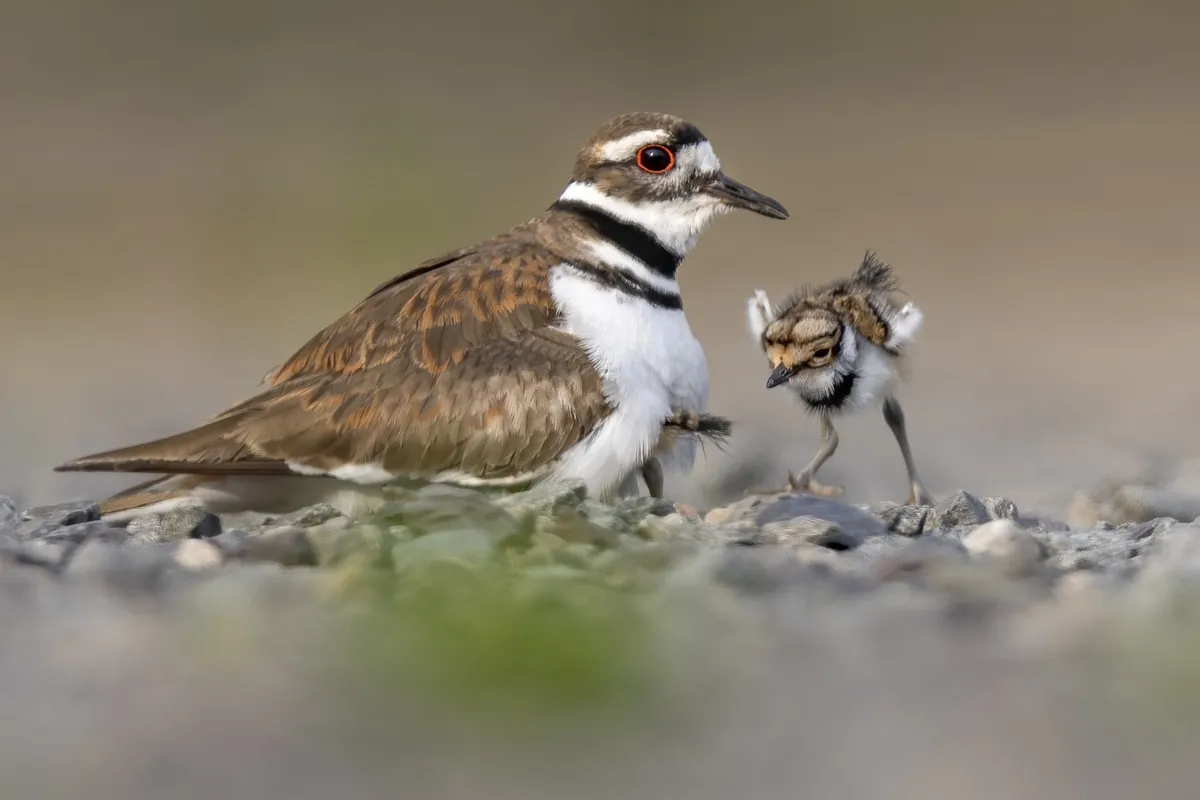
That alarm often comes with the famous broken-wing display: the bird drags a wing, fans its tail and stumbles along as if injured, leading the intruder away from the eggs, then suddenly "recovers" and flies off. If a killdeer is screaming and limping near you, there is almost certainly a nest or chicks close by. The eggs sit in a shallow scrape on bare ground and are speckled to blend with gravel. Chicks can run within hours of hatching and leave the nest soon after. See other night callers on the animal noises at night page.
Killdeer facts
- Size
- About 10.5 inches long, with a wingspan of about 24 inches. Killdeer (Tennessee Wildlife Resources Agency)
- Weight
- About 3.3 oz. Killdeer (Tennessee Wildlife Resources Agency)
- Lifespan
- The oldest known wild killdeer lived at least 10 years, 11 months. Charadrius vociferus (Animal Diversity Web)
- Diet
- Ground-dwelling invertebrates, especially earthworms, grasshoppers, beetles and snails. Killdeer (Tennessee Wildlife Resources Agency)
- Active
- Active both day and night, which is why its calls are heard after dark. Charadrius vociferus (Animal Diversity Web)
- Habitat
- Open ground: pastures, plowed fields, athletic fields, airports, golf courses, gravel lots, sandbars and mudflats. Killdeer (Tennessee Wildlife Resources Agency)
- Conservation status
- Near Threatened (IUCN Red List, 2024) Charadrius vociferus (IUCN Red List)
Where it lives: Found in nearly every state in the lower 48.
Year-roundSummer (breeding)Sounds like… but isn't
- Eastern whip-poor-will: A whip-poor-will sings a steady three-part "whip-poor-WILL" from the woods, while a killdeer gives a shrill two-part cry from open ground or in flight.
- Northern mockingbird: A mockingbird may include a killdeer-like note in its song but quickly switches to other phrases; a killdeer keeps repeating the same cry.
Should I worry?
No. Killdeer are harmless, and their calls at night are just noise. A killdeer dragging its wing is not hurt; the broken-wing act is a distraction to lead you away from its nest. The National Park Service advises leaving the area when you see the display, which lets the bird get back to its eggs or chicks.
Killdeer often nest on gravel parking lots, driveways, sports fields and golf courses. If you find a nest, leave it alone. Idaho's parks agency suggests placing a marker nearby so you know where to give it a wide berth, for example when mowing or driving.
Killdeer are protected under the federal Migratory Bird Treaty Act, which prohibits taking migratory birds without authorization from the U.S. Fish and Wildlife Service. Do not move the eggs or try to relocate the nest.
Sources: Killdeer - Mississippi National River & Recreation Area (National Park Service); Portals to Parks: Killdeer (Idaho Department of Parks and Recreation); Migratory Bird Treaty Act of 1918 (U.S. Fish & Wildlife Service).
Questions people ask
What does a killdeer sound like?
A loud, shrill, whistled "kill-deer" or "kill-dee," often repeated, plus rapid trilling "dee-dee-dee" alarm calls when something approaches its nest.
Why do killdeer call at night?
Killdeer are active day and night. They call at night to keep in contact, defend territory and react to disturbances, and they often call in flight over lit parking lots and fields, especially in spring and summer and during migration.
Why is a bird pretending to have a broken wing?
That is a killdeer's broken-wing display, a distraction to lure you or a predator away from its eggs or chicks. Step away from the area so the bird can return to its nest.
There is a killdeer nest in my parking lot. What should I do?
Leave it in place. Mark the spot or block it off so cars and mowers avoid it, and keep people and dogs away. Killdeer are protected by federal law, so do not move the eggs or the nest.
Is the killdeer a shorebird?
Yes, it is a plover, but it lives mostly away from water, on fields, lawns, gravel lots and other open ground.
Are killdeer endangered?
No. But in its 2024 assessment the IUCN Red List classed the killdeer as Near Threatened, one step below the threatened categories.
Please don't play these recordings at wild animals, especially in parks: it can stress them, and many parks prohibit it.