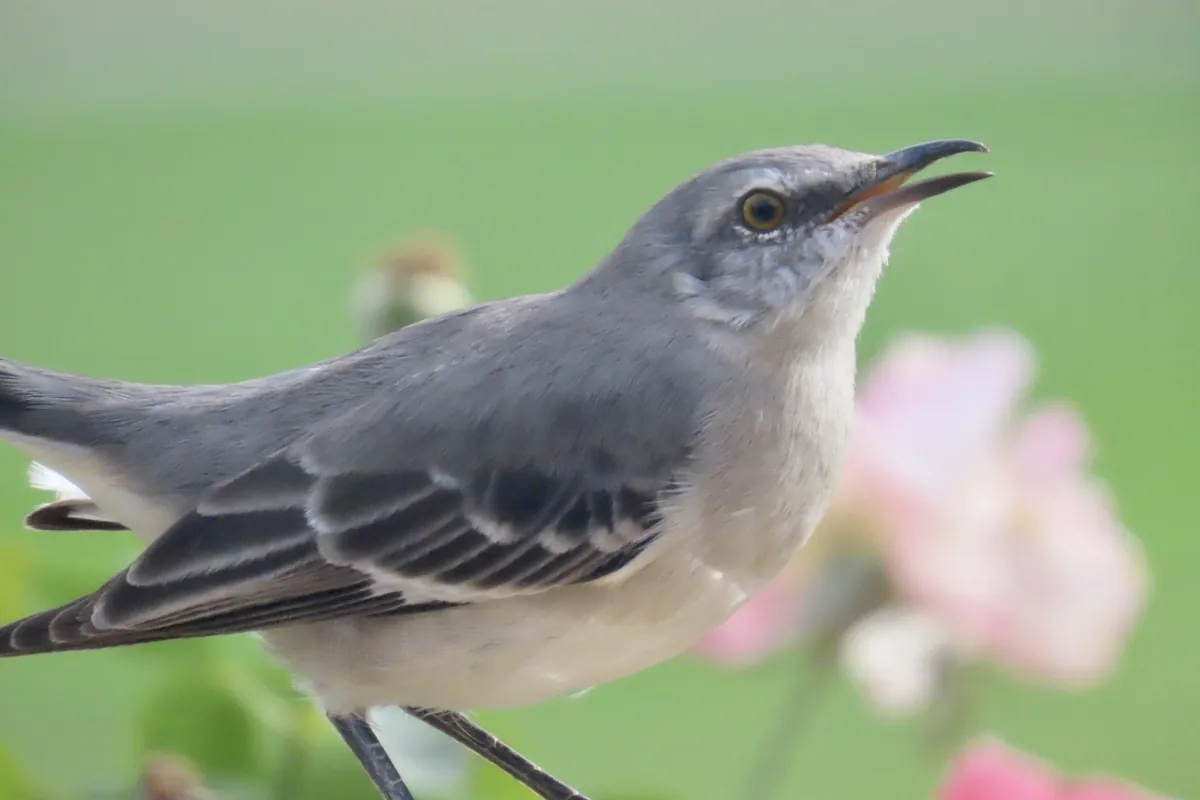
What you're hearing
When
Mockingbirds sing for much of the year in daylight, but night singing happens mainly in spring and early summer during the breeding season. It is often most noticeable on moonlit nights and near streetlights, porch lights and other bright outdoor lighting.
The bird singing at 2 a.m. is usually an unmated male. Once he attracts a mate, night singing typically stops.
Where
Northern mockingbirds live year-round across most of the lower 48 states, most commonly in the South, Southwest and California, and less commonly in the northernmost states.
They thrive around people: suburban yards, parks, shopping centers and city streets with shrubs, lawns and open perches. A male will often sing from the top of a chimney, roof, utility pole, TV antenna or the tallest shrub in the yard, or from a hidden perch inside a tree.
Why it calls
Singing is how a male defends his territory and attracts a mate. Male mockingbirds learn a large repertoire, much of it copied from other birds, along with sounds such as frogs, insects, car alarms and squeaky hinges. Females are drawn to males with the most varied songs, and unmated males sing more than mated ones, including through the night.
Other birds that sing at night. Mockingbirds are the most common answer across much of the US, but not the only one. In eastern woods, a nonstop three-part whistle is a whip-poor-will. Loud "kill-deer" cries over a parking lot or field are a killdeer. American robins sometimes sing before dawn or under bright lights, and many songbirds call in flight on spring and fall migration nights. For hoots, screams and other night noises, use the animal noises at night identifier.
Northern mockingbird facts
- Size
- About 8.2 to 10 inches (20.8 to 25.5 cm) long; males run slightly larger than females. Mimus polyglottos (Animal Diversity Web)
- Weight
- Averages about 1.7 to 1.8 oz (47 g for females, 51 g for males). Mimus polyglottos (Animal Diversity Web)
- Lifespan
- The oldest known northern mockingbird in the wild reached 14 years, 10 months. Northern Mockingbird (Tennessee Wildlife Resources Agency)
- Diet
- Omnivore: mostly insects such as beetles, ants and grasshoppers, plus spiders, berries and seeds. Mimus polyglottos (Animal Diversity Web)
- Active
- Active by day, but males often sing at night as well as during the day. Mimus polyglottos (Animal Diversity Web)
- Calls peak
- Night song is most noticeable on moonlit spring nights, usually from unmated males; in well-lit spots mated males may join in. Northern Mockingbird (Tennessee Wildlife Resources Agency)
- Habitat
- Open ground with shrubs: parks, farmland and suburbs, with a fondness for multiflora rose thickets. Northern Mockingbird (Tennessee Wildlife Resources Agency)
- Conservation status
- Least Concern (IUCN Red List, 2025) Mimus polyglottos (IUCN Red List)
Where it lives: Found in nearly every state in the lower 48.
Year-roundSounds like… but isn't
- Eastern whip-poor-will: A whip-poor-will repeats one three-part phrase endlessly, while a mockingbird switches to a new phrase every few repeats.
- Killdeer: A mockingbird may slip in a killdeer-like call, but it moves on to other sounds within seconds; a real killdeer keeps repeating its shrill cry, often while flying.
- Gray treefrog: Mockingbirds can imitate frog trills, but a real gray tree frog repeats the same short trill steadily for hours and does not mix in other sounds.
Should I worry?
No. A mockingbird singing at night is harmless, though it can cost you sleep. Since night singers are generally unmated males, the singing usually stops once he finds a mate or the breeding season winds down. Earplugs or a fan in the meantime are the practical fix.
Mockingbirds are very territorial in the breeding season and aggressively defend their nests, diving at and sometimes striking people, pets and other animals that get too close. If one is dive-bombing you, it is protecting a nest nearby. Give the area a wide berth for a few weeks until the young leave.
Mockingbirds are protected under the federal Migratory Bird Treaty Act, which prohibits killing, capturing or otherwise taking them without authorization from the U.S. Fish and Wildlife Service, so do not try to remove the bird or its nest.
Sources: Northern Mockingbird (Mimus polyglottos) (Texas Parks and Wildlife Department); Gray Catbird, Northern Mockingbird, and Brown Thrasher (Pennsylvania Game Commission); Migratory Bird Treaty Act of 1918 (U.S. Fish & Wildlife Service).
Questions people ask
What bird sings at night?
In most of the US, a bird singing a long, varied song at night is a northern mockingbird, usually an unmated male in spring or early summer. Other night singers include whip-poor-wills in eastern woods and killdeer over open ground, and robins sometimes sing under bright lights.
Why is a bird singing at 3 a.m.?
Most likely it is an unmated male mockingbird advertising for a mate. Night singing is most common on moonlit nights and near bright lights, and it usually stops once he pairs up.
How do I get a mockingbird to stop singing at night?
There is no reliable or legal way to silence a wild bird; mockingbirds are protected by federal law. The singing usually ends once the male finds a mate or the breeding season ends. Earplugs or white noise help in the meantime.
What does a mockingbird sound like?
A long, rambling medley of borrowed phrases, each typically repeated several times before the bird moves on to the next. It may include other birds' songs, frog and insect sounds, and mechanical noises such as car alarms.
Why is a mockingbird attacking me or my dog?
It is defending a nest nearby. Mockingbirds dive at people and animals that come close during the breeding season. Avoid the spot for a few weeks until the young leave the nest.
How long do mockingbirds live?
The oldest wild northern mockingbird on record reached 14 years, 10 months, according to the Tennessee Wildlife Resources Agency.
Please don't play these recordings at wild animals, especially in parks: it can stress them, and many parks prohibit it.