What you're hearing
When
Spring peepers are among the earliest frogs to call each year. In the South they can start in winter; farther north the chorus begins in late winter or early spring, as soon as ponds thaw and nights turn mild, and continues into late spring. Calling starts around dusk and goes on well into the night.
You may also hear a lone peeper calling from the woods on a mild fall day. These scattered fall calls are normal and are not a sign of a breeding chorus.
Where
Spring peepers live throughout the eastern United States and southeastern Canada. They are woodland frogs that breed in fishless water: small ponds, temporary woodland pools, swamps, flooded fields and roadside ditches with thick vegetation nearby. Wooded suburbs and rural areas with any wet spot often have them.
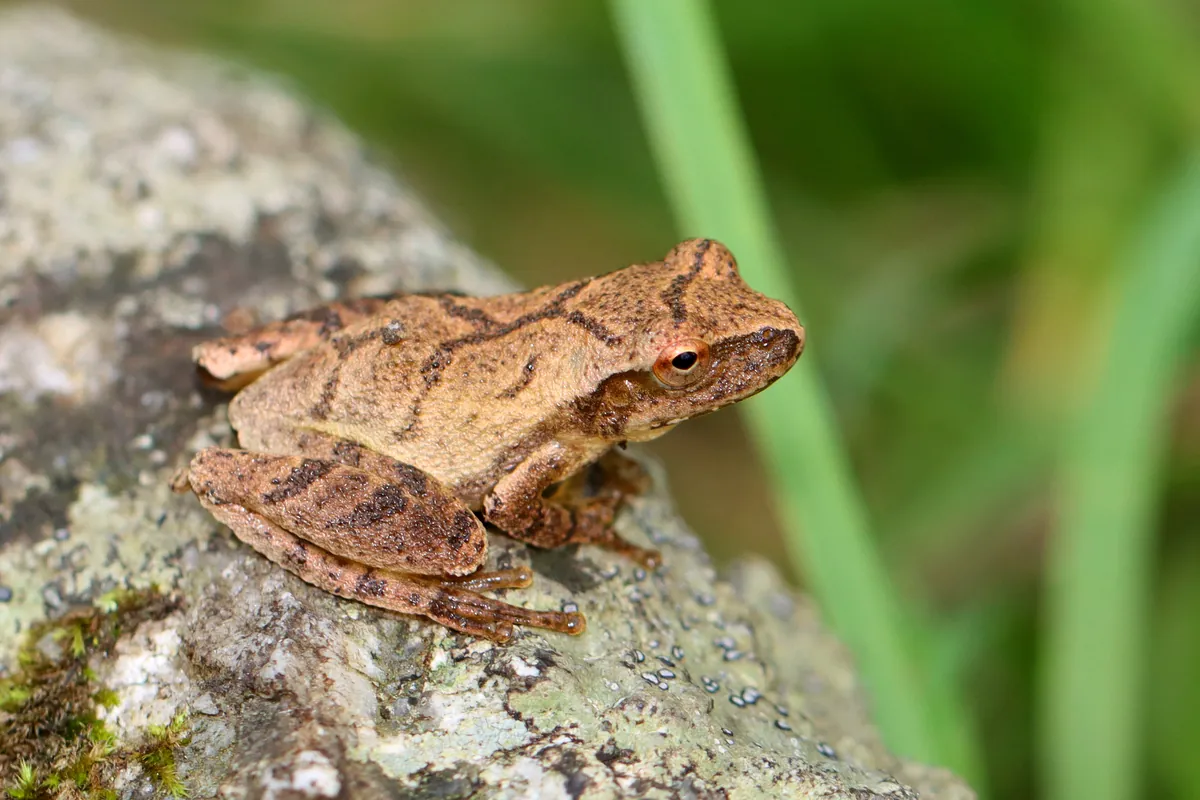
They are tiny, about an inch long, tan or brown with a dark X-shaped mark on the back, so a loud chorus can come from a pool where you will rarely see a single frog.
Why it calls
Males call to attract females to the breeding pools. A chorus is many males calling at once, each from his own spot near the water. When males crowd too close, they switch from the clean peep to a short, rough trill aimed at rivals.
Their choruses are traditionally greeted as a sign that winter is over.
Spring peeper facts
- Size
- ¾ to 1¼ inches from snout to vent, occasionally 1½ inches; males are smaller than females. Spring Peeper (Missouri Department of Conservation)
- Weight
- About 0.11 to 0.18 oz (3 to 5 g). Pseudacris crucifer (Animal Diversity Web)
- Lifespan
- Wild lifespan unknown; 3 to 4 years in captivity. Pseudacris crucifer (Animal Diversity Web)
- Diet
- Small insects and spiders it finds in leaf litter and other ground debris. Spring Peeper (Missouri Department of Conservation)
- Active
- Nocturnal and secretive, usually on the ground or hidden in leaf litter. Pseudacris crucifer (Animal Diversity Web)
- Calls peak
- Breeding choruses late February to mid-May (Missouri) on warm spring nights; scattered calls into fall. Spring Peeper (Missouri Department of Conservation)
- Habitat
- Woodlands near ponds, streams or swamps with thick undergrowth; breeds in fishless woodland pools. Spring Peeper (Missouri Department of Conservation)
- Conservation status
- Least Concern (IUCN Red List, 2020) Pseudacris crucifer (IUCN Red List)
Where it lives: Found in all of the Northeast; all of the Mid-Atlantic and Southeast; most of the Midwest (not North Dakota, South Dakota, Nebraska); most of the Southwest and southern Plains (not New Mexico, Arizona).
Year-roundSounds like… but isn't
- Cricket: Crickets chirp in late summer and fall in quick, repeated notes, while peepers call in early spring with single rising whistles from wet ground.
- Gray treefrog: Gray treefrogs start later in spring and give a rattling, musical trill, not a single clear peep.
Which frog is that? Compare frog calls →
Should I worry?
No. Spring peepers are small, common native frogs, and their peeping, jingling choruses are welcomed in many places as a sign of spring. Breeding choruses are seasonal and fade by late spring.
If you have a wet spot or ditch where they gather, leaving it alone through spring lets their tadpoles finish developing. Do not move frogs or tadpoles to another pond, and never release purchased or pet frogs into the wild; amphibian diseases such as ranavirus have been spread by moving animals. If you raise tadpoles you collected, release them back where you found them, and wash your hands before and after handling amphibians.
Sources: Spring Peeper (Missouri Department of Conservation); Problems with Buying Frogs and Tadpoles for Wild Release (Maryland Department of Natural Resources).
Questions people ask
What does a spring peeper sound like?
A single high, clear peep that rises slightly at the end, repeated about once a second. Many together sound like a ringing of small bells.
Why are spring peepers so loud for such small frogs?
Each male inflates a large vocal sac under his chin that helps the call carry, and dozens or hundreds may call from the same pool at once.
When do spring peepers start and stop calling?
They start in late winter or early spring once nights are mild and water is open, and the breeding chorus fades by late spring. Scattered single calls can be heard again in fall.
Why do frogs call at night?
Males call to attract females to breeding water, and night is when the air is cool and humid and frogs are safer from predators that hunt by sight.
Why do I hear peepers in the fall?
Some peepers call again on mild fall days and evenings, usually one or two at a time from the woods rather than a full chorus. It is normal behavior and does not mean they are breeding.
How big is a spring peeper?
Tiny: adults are about ¾ to 1¼ inches long, so they are far easier to hear than to find. Source: Missouri Department of Conservation.
Please don't play these recordings at wild animals, especially in parks: it can stress them, and many parks prohibit it.