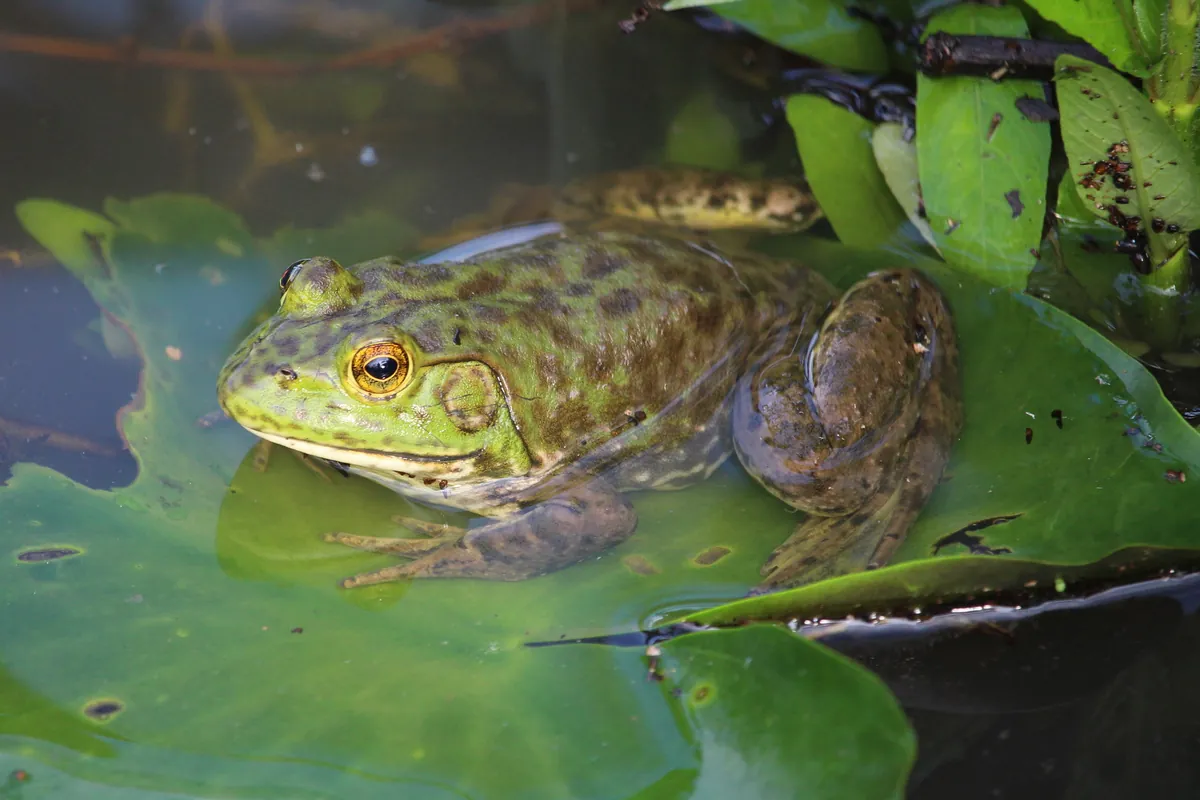
What you're hearing
When
Bullfrogs call from late spring through summer. Males start calling in spring once the water warms, and the biggest choruses come in early to midsummer, during the breeding season. They can call during the day and just after sunset, but the heaviest calling during breeding season is in the middle of the night, from around midnight to the early morning hours.
Where
Bullfrogs are native to the central and eastern United States. They have been introduced in many western states, including California, Oregon and Washington, where they are now widespread.
They are the most aquatic of our frogs and need permanent water: ponds, lakes, reservoirs, slow rivers, golf-course water hazards and larger backyard or farm ponds. If you hear one, there is a permanent body of water nearby.
Why it calls
The call is made by males to attract females and to claim a calling spot along the shore. Males defend these territories against other males during the breeding season, which is why calling bullfrogs are spaced out around a pond rather than bunched together.
A bullfrog that gives a short squeak or yelp as it jumps into the water is startled, not calling.
American bullfrog facts
- Size
- Adults are usually 3½ to 6 inches from snout to vent, occasionally up to 8¾ inches. American Bullfrog (Missouri Department of Conservation)
- Weight
- Up to about 1.1 pounds (0.5 kg). Lithobates catesbeianus (Animal Diversity Web)
- Lifespan
- Typically 7 to 9 years in the wild; the record in captivity is 16 years. Lithobates catesbeianus (Animal Diversity Web)
- Diet
- Almost anything it can swallow: insects, spiders, crayfish, fish, other frogs, even birds and small mammals. American Bullfrog (Missouri Department of Conservation)
- Active
- Active day and night, most of all in warm, moist weather. Lithobates catesbeianus (Animal Diversity Web)
- Calls peak
- Big choruses from mid-May into July (Missouri); calling is most intense from midnight until 3 or 4 a.m. American Bullfrog (Missouri Department of Conservation)
- Habitat
- Permanent water: lakes, ponds, rivers, large creeks, ditches, sloughs, swamps and marshes. American Bullfrog (Missouri Department of Conservation)
- Conservation status
- Least Concern (IUCN Red List, 2020) Aquarana catesbeianus (IUCN Red List)
Where it lives: Found in nearly every state in the lower 48.
Year-roundSounds like… but isn't
- Great horned owl: A great horned owl gives soft, evenly spaced hoots from trees, while a bullfrog's call is a lower, buzzing, drawn-out rumble that comes from the water's edge.
- Gray treefrog: Gray treefrogs give a short, high, musical trill from trees, nothing like the bullfrog's deep bass drone.
Which frog is that? Compare frog calls →
Should I worry?
Bullfrogs pose no danger to people. Where they are native, in the central and eastern states, they are a normal part of pond life; Missouri, for example, classifies them as a game animal protected by a season and bag limit, so check your state's rules before taking any.
In the West they are an invasive species. They prey on and out-compete native frogs and other aquatic animals and can carry chytrid fungus, a disease that kills amphibians. California asks residents to report sightings to its Invasive Species Program. Washington considers bullfrogs an invasive problem species: they can be controlled without a permit, no license is required and there is no bag limit, but it is illegal there to transport live bullfrogs or tadpoles.
Wherever you live, do not move frogs or tadpoles from one pond to another, and never release purchased or pet frogs into the wild; amphibian diseases such as ranavirus have been spread by moving animals.
Sources: American bullfrog (Washington Department of Fish & Wildlife); California's Invaders: American Bullfrog (California Department of Fish and Wildlife); Problems with Buying Frogs and Tadpoles for Wild Release (Maryland Department of Natural Resources).
Questions people ask
What does a bullfrog sound like?
A deep, resonant drone or bellow, usually written "jug-o-rum," repeated a few times in a series. It is much lower than any other common frog call in North America.
Why do bullfrogs croak at night?
Males call to attract females and defend their spot on the shore during the summer breeding season, and calling is heaviest late at night when it is cool and predators have a harder time finding them.
How far can you hear a bullfrog?
Far. A bullfrog's call is loud and low-pitched, so it carries across a pond and well beyond it on a still night.
How can I tell a bullfrog from a green frog?
Green frogs give a single short "gunk" like a plucked loose banjo string. Bullfrogs give a longer, deeper, drawn-out "jug-o-rum" that is usually repeated several times in a row.
Are bullfrogs invasive?
Only outside their native range. They are native to the central and eastern United States but invasive in the West, where states such as California and Washington ask the public to report them, and Washington allows them to be controlled without a permit.
Should I move bullfrogs or tadpoles to my pond?
No. Moving frogs and tadpoles between ponds can spread amphibian diseases, and in states where bullfrogs are invasive, such as Washington, transporting live bullfrogs is illegal.
How big do bullfrogs get?
Adults are usually 3½ to 6 inches long from snout to vent, and big ones reach about 8¾ inches. Large adults can weigh up to about a pound. Source: Missouri Department of Conservation.
How long do bullfrogs live?
Typically 7 to 9 years in the wild, according to Animal Diversity Web. One captive bullfrog lived 16 years.
Please don't play these recordings at wild animals, especially in parks: it can stress them, and many parks prohibit it.