What you're hearing
When
Gray treefrogs call from spring into summer. Males begin calling at breeding sites once nights warm up, and breeding runs from about April into early summer, sometimes later. Calling is mostly at dusk and through the night, but you may also hear a single trill from a tree during a warm, humid day or just before rain.
Where
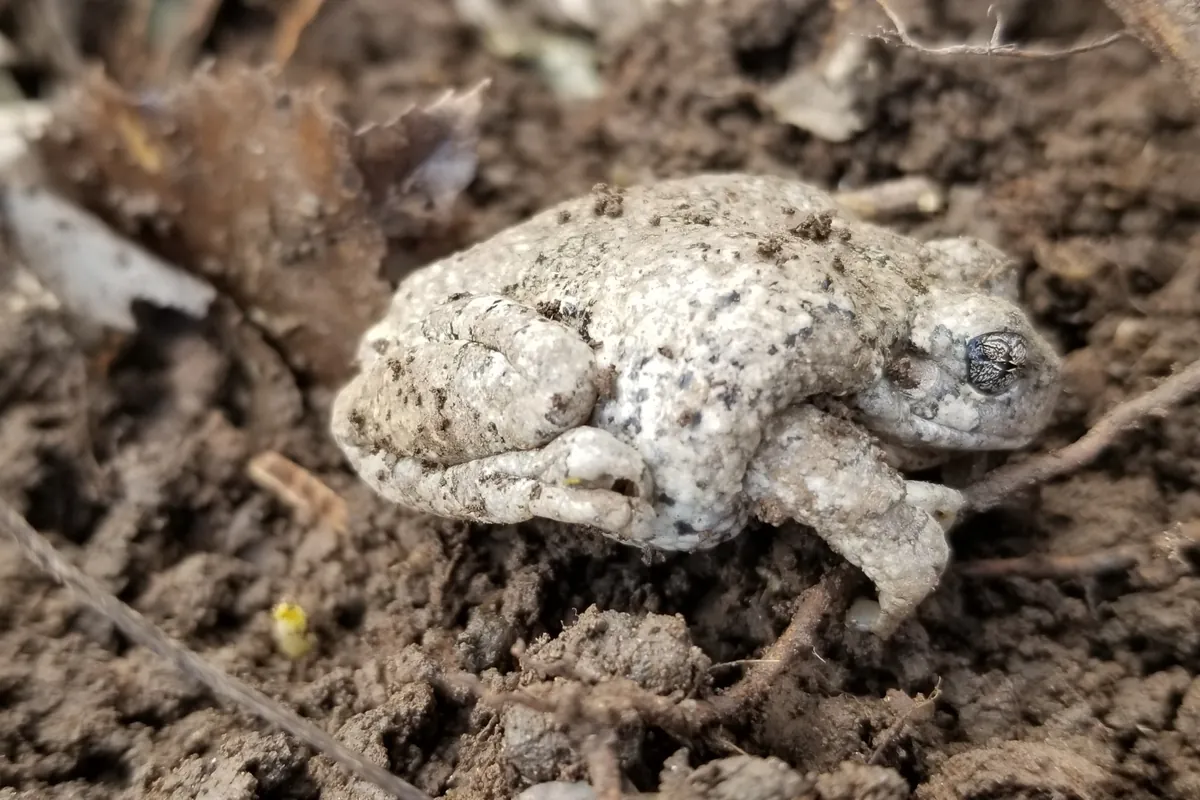
Gray treefrogs live across much of the eastern half of the United States, in woodlots, wooded suburbs, and trees along streams and ponds. They are excellent climbers and spend summer days tucked into cracks, knotholes and other cavities.
They often turn up around houses: on porches and decks, in gutters and birdhouses, and on windows at night, where they gather near porch lights to catch insects. Breeding choruses form at ponds, flooded ditches and other shallow water, including backyard ponds and pools.
Why it calls
Males trill to attract females to the water to breed. Each species of frog has its own call, and females recognize the call of their own species.
There are actually two gray treefrogs that look almost identical: the gray treefrog (Dryophytes versicolor) and Cope's gray treefrog (Dryophytes chrysoscelis). The easiest way to tell them apart is by ear. The gray treefrog's trill is slower and more musical and birdlike; Cope's is faster, higher and buzzier. Temperature changes both calls, so it takes practice.
Gray treefrog facts
Gray treefrog and Cope's gray treefrog look nearly identical; each fact says which species it covers.
- Size
- Both species: usually 1¼ to 2½ inches from snout to vent, occasionally larger; Cope's tends to be slightly smaller. Gray Treefrog and Cope's Gray Treefrog (Missouri Department of Conservation)
- Weight
- Gray treefrog: averages about 0.25 oz (7.2 g). Hyla versicolor (Animal Diversity Web)
- Lifespan
- Wild lifespan unknown; one captive gray treefrog lived more than 7 years. Hyla versicolor (Animal Diversity Web)
- Diet
- Both species: insects, spiders and other invertebrates; ants and beetles can be nearly three-quarters of the diet. Gray Treefrog and Cope's Gray Treefrog (Missouri Department of Conservation)
- Active
- Gray treefrog: nocturnal and crepuscular (active at night, dawn and dusk). Hyla versicolor (Animal Diversity Web)
- Calls peak
- Both species: early April to early July, sometimes August (Missouri), once nights warm to about 60°F. Gray Treefrog and Cope's Gray Treefrog (Missouri Department of Conservation)
- Habitat
- Woodlots and trees near water; gray treefrog leans toward forest, Cope's toward grassland and oak savanna. Gray Treefrog and Cope's Gray Treefrog (Missouri Department of Conservation)
- Conservation status
- Least Concern (IUCN Red List, 2020; gray treefrog) Dryophytes versicolor (IUCN Red List)
Where it lives: Found in all of the Northeast; all of the Mid-Atlantic and Southeast; all of the Midwest; most of the Southwest and southern Plains (not New Mexico, Arizona).
Year-roundSounds like… but isn't
- Screech owl: An eastern screech-owl gives a soft, hollow, even-pitched trill or a descending whinny, while a treefrog's trill is louder, harsher and stops after a second or two.
- Spring peeper: Spring peepers give single high peeps over and over in early spring, not a continuous trill.
- Cricket: Crickets chirp steadily for long stretches, while a treefrog's trill lasts a second or two followed by a pause.
Which frog is that? Compare frog calls →
Should I worry?
No. Gray treefrogs are a common native species and a welcome one: they eat many insects, including those drawn to porch lights. A frog on your window or deck needs no help and will move on by itself.
If you handle one, wash your hands before and after. Do not move frogs or tadpoles to another pond, and never release purchased or pet frogs into the wild; amphibian diseases such as ranavirus have been spread by moving animals. If you raise tadpoles you collected, release them back at the same spot where you found them.
Sources: Gray Treefrog and Cope's Gray Treefrog (Missouri Department of Conservation); Problems with Buying Frogs and Tadpoles for Wild Release (Maryland Department of Natural Resources).
Questions people ask
What does a tree frog sound like?
Across much of the eastern U.S., the tree frog you hear is often a gray treefrog, which gives a loud, musical trill about a second or two long, repeated every several seconds. Many people first think it is a bird.
Why do tree frogs call at night?
Males call to attract females to breeding water, and they do most of it after dark when the air is humid and they are safer from predators that hunt by sight.
Why is a tree frog calling from my tree or gutter, far from water?
Gray treefrogs live in trees and around buildings outside the breeding season and sometimes call from there, especially on warm, humid evenings or before rain.
How do I tell gray treefrog and Cope's gray treefrog apart?
By the trill. The gray treefrog's is slower and more musical; Cope's is faster and buzzier. They look nearly the same, so the call is the most practical clue.
Why are frogs on my windows at night?
They are hunting. Lights draw insects to windows and porches, and treefrogs climb up to catch them.
How big do gray tree frogs get?
Small: usually 1¼ to 2½ inches long from snout to vent, with Cope's gray treefrog tending to be a little smaller than the gray treefrog. Source: Missouri Department of Conservation.
Please don't play these recordings at wild animals, especially in parks: it can stress them, and many parks prohibit it.