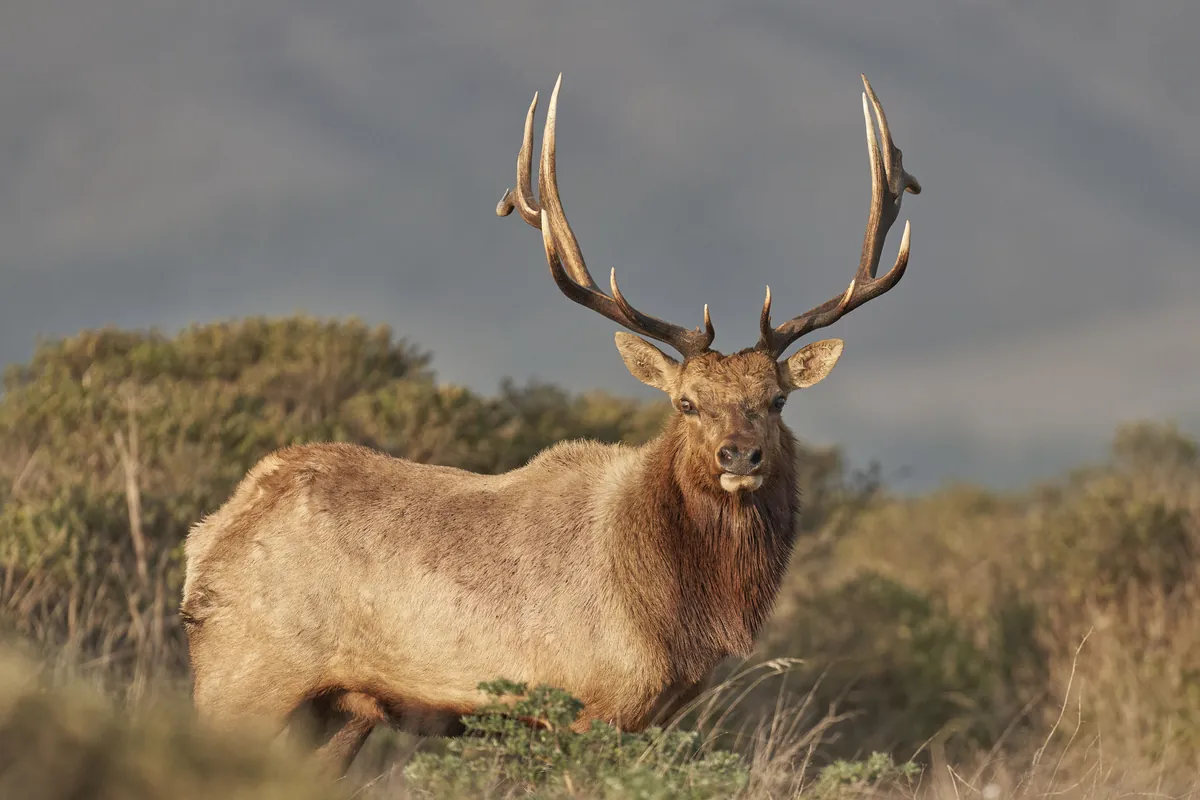
What you're hearing
When
Bugling is a fall sound. It builds in late August, peaks during the rut in September and early October, and tapers off after that. Bulls bugle most around dawn and dusk and through the night, but in the peak of the rut they can bugle at any hour.
Cow and calf mews and chirps can be heard year-round wherever a herd is feeding, and become more noticeable in late spring and summer when calves are young.
Where
Most elk live in the Rocky Mountain states and the Pacific Northwest, from mountain forests down to valley meadows in winter. Restored herds also live in parts of the East and Midwest, including Pennsylvania, Kentucky, Arkansas, Michigan and the Great Smoky Mountains in North Carolina.
Elk feed in open meadows and fields, often at the edges of forest. In some mountain towns and national parks they graze on lawns, golf courses and road edges, which is how many people first hear a bugle up close.
Why it calls
The bugle is a bull's advertisement during the rut. It announces him to cows and challenges other bulls, and rival bulls will answer each other back and forth. The grunts or chuckles at the end, and the low grunts bulls make while herding cows, are part of the same display.
Cows and calves mew and chirp to keep track of each other while feeding and moving. A sharp, single bark is an alarm call that tells the herd something has startled it.
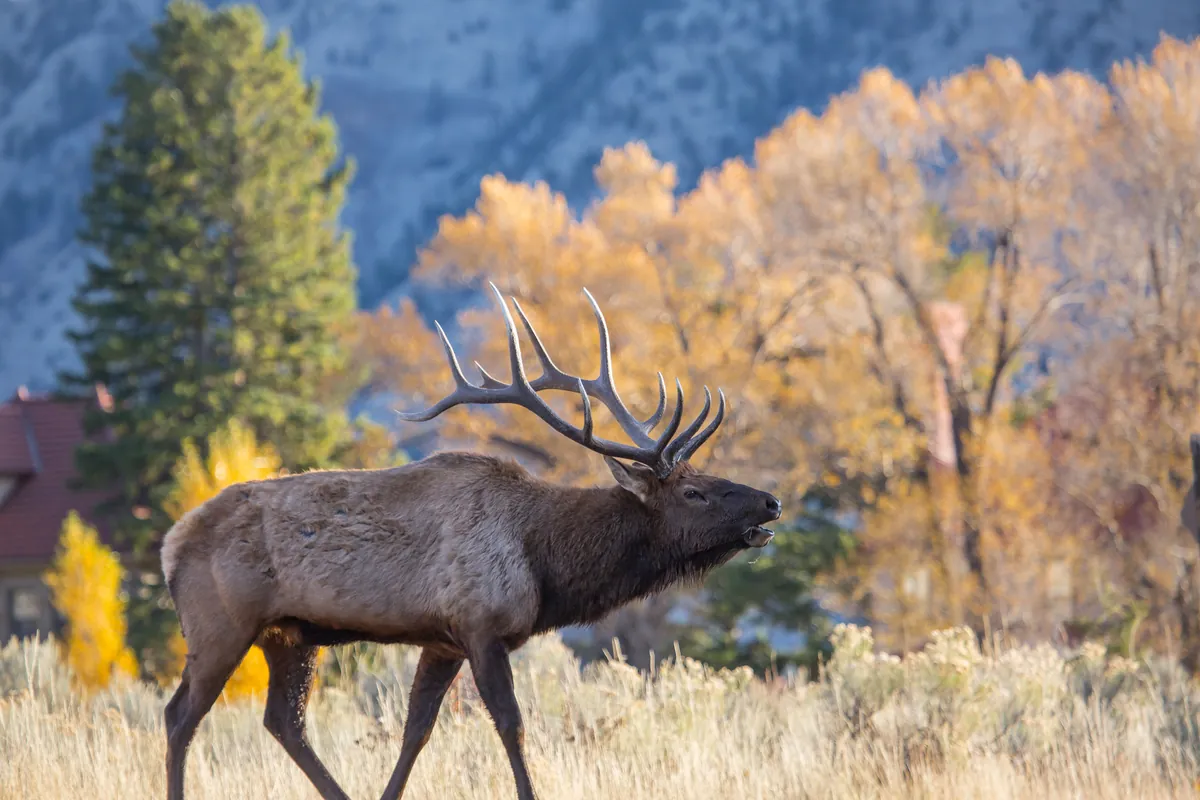

Elk facts
- Size
- Bulls stand about 5 ft. at the shoulder and run about 8 ft. long; cows about 4.5 ft. tall and 6 ft. long. Elk (Rocky Mountain National Park, NPS)
- Weight
- Bulls 700-1,000 lb. (up to about 1,100 lb. entering the rut); cows 300-500 lb. Elk (Rocky Mountain National Park, NPS)
- Lifespan
- About 10-13 years in the wild. Elk (Rocky Mountain National Park, NPS)
- Diet
- Mostly grasses and wildflowers, plus shrubs; around 20 lb. of plants a day. Elk (Rocky Mountain National Park, NPS)
- Active
- Feed mainly in the morning and evening and rest under cover at midday. Elk (Rocky Mountain National Park, NPS)
- Calls peak
- The fall rut: bulls bugle to open the mating season, and the calls carry through autumn nights. Elk (Rocky Mountain National Park, NPS)
- Habitat
- Meadow valleys in fall and winter; higher elevations, up to alpine tundra, in summer. Elk (Rocky Mountain National Park, NPS)
- Conservation status
- Least Concern (IUCN Red List, 2015) Cervus canadensis, Wapiti (IUCN Red List)
Where it lives: Found in parts of the Northeast (Pennsylvania); parts of the Mid-Atlantic and Southeast (Kentucky, Tennessee); parts of the Midwest (Michigan, Minnesota, South Dakota, Nebraska); all of the Southwest and southern Plains; all of the Mountain West; all of the Pacific Coast.
Year-roundSounds like… but isn't
- Moose: Moose make low grunts and long, wavering moans; they never produce the high, rising whistle of an elk bugle.
- White-tailed deer: A deer's alarm is a whooshing snort through the nose, while an elk's alarm is a sharper, voiced bark.
Should I worry?
Elk are not predators, but bulls in the fall rut are unpredictable and much more aggressive, and people have been seriously injured. Stay at least 25 yards away from elk at all times, and farther is better. In some national parks, including Great Smoky Mountains, approaching elk within 25 yards is illegal.
If an elk comes toward you, back away. If one charges, get into your vehicle or behind a tall, sturdy barrier as fast as you can. Look around before stepping out of buildings or cars in places where elk graze, and use a long camera lens instead of walking closer for a photo.
Sources: WARNING: Stay away from bull elk in Yellowstone, especially during fall mating season (National Park Service, Yellowstone); Great Smoky Mountains National Park Reminds Visitors to View Elk and Black Bears Safely this Fall (National Park Service).
Questions people ask
What does an elk bugle sound like?
It starts as a low, hoarse note, slides up into a high, piercing whistle that can sound almost like a scream, then often drops into a series of grunts. Across a valley at night it sounds eerie and is easy to mistake for something else.
When do elk bugle?
Mainly during the fall rut, from late August into October, with the peak in September. Bulls call most at dawn, dusk and night, but in the peak of the rut they bugle at any time of day.
Why do elk bugle?
Bulls bugle to attract cows and to challenge rival bulls. When one bull bugles, others nearby often answer.
Do female elk bugle?
Cows do not give the full bugle. They make softer mews, chirps and squeals to stay in contact with the herd and their calves, and either sex can give a sharp alarm bark.
Is it dangerous to be near elk during the rut?
It can be. Bull elk in the rut are aggressive and unpredictable. Stay at least 25 yards away, and if one charges, get into a vehicle or behind a solid barrier.
How big is an elk?
A bull elk stands about 5 feet at the shoulder and weighs roughly 700 to 1,000 pounds; cows are smaller, about 4.5 feet tall and 300 to 500 pounds (NPS, Rocky Mountain National Park).
Please don't play these recordings at wild animals, especially in parks: it can stress them, and many parks prohibit it.