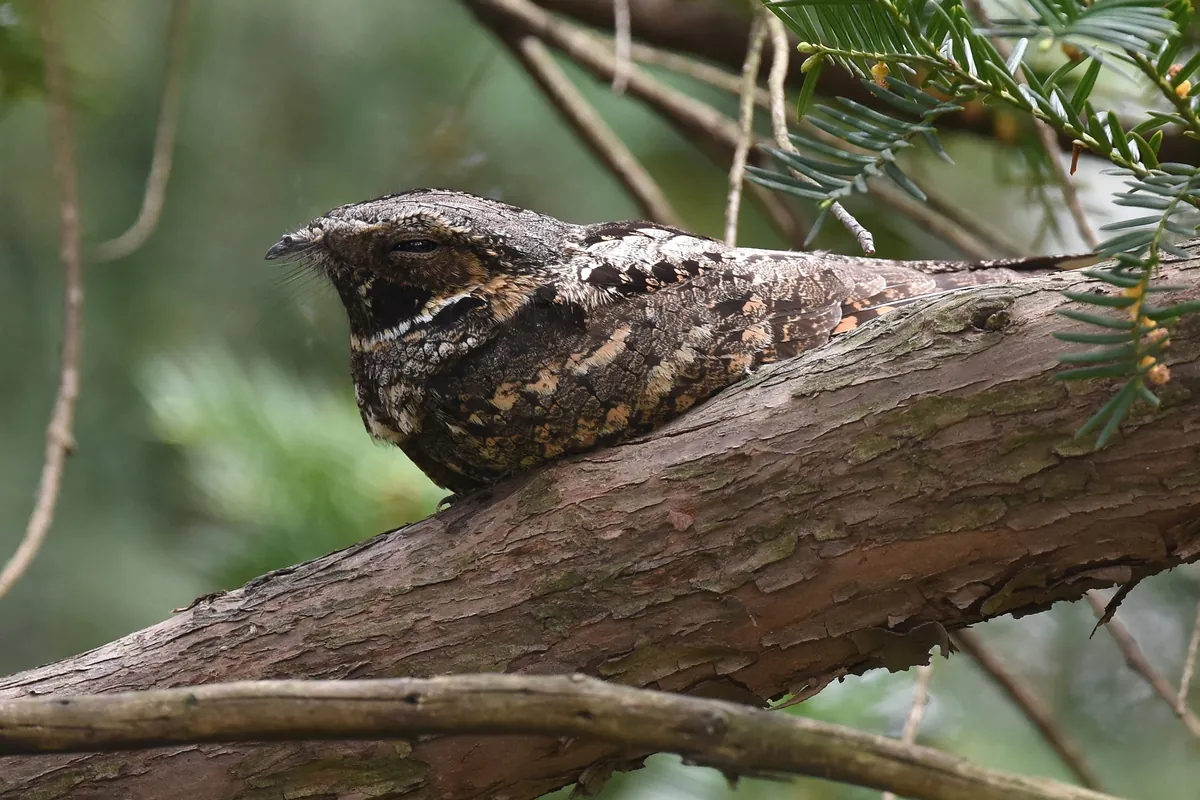
What you're hearing
When
Eastern whip-poor-wills arrive on their breeding grounds in spring and sing through spring and early summer, becoming quieter later in the summer before they migrate south in fall.
They sing at dusk, through the night and around dawn, and are especially active on moonlit nights, when they can see the moths they hunt. A single bird may repeat its song hundreds of times in a night, often from the same spot near a house or campsite.
Where
The Eastern whip-poor-will breeds across much of the eastern United States and southeastern Canada, from the Great Lakes and New England south through the Appalachians and Ozarks, and west to the edge of the Great Plains. It spends the winter along the Gulf Coast and in Mexico and Central America.
It lives in dry forests and woodlands with open understories, often near clearings, fields and woodland edges. Homes and campsites next to woods are where most people hear one. A related species, the Mexican whip-poor-will, sings a slower, burrier song in the mountains of Arizona, New Mexico and western Texas.
Why it calls
The song is given by males. It advertises a territory and attracts a mate, which is why it is repeated so persistently during the breeding season.
Whip-poor-wills are nightjars: they hunt flying insects at night and spend the day resting on the ground or on a branch, camouflaged so well among dead leaves that most people never see one. If the song you heard was slower, with a soft first note and an emphasis on the middle ("chuck-will's-WID-ow"), it was its larger southern relative, the chuck-will's-widow. See other night singers on the animal noises at night page.
Eastern whip-poor-will facts
- Size
- About 9.75 in. long with a 19 in. wingspan. Eastern Whip-poor-will (Tennessee Wildlife Resources Agency)
- Weight
- About 1.9 oz. Eastern Whip-poor-will (Tennessee Wildlife Resources Agency)
- Lifespan
- Up to 15 years recorded in the wild. Caprimulgus vociferus (Animal Diversity Web)
- Diet
- Flying insects caught in the air, especially moths, plus beetles and grasshoppers. Eastern Whip-poor-will (Missouri Department of Conservation)
- Active
- Most active in the evening and at dawn, and especially on moonlit nights. Eastern Whip-poor-will (Missouri Department of Conservation)
- Calls peak
- Late spring and early summer, mostly after dusk and before dawn; moonlit nights are best. Eastern Whip-poor-will (Tennessee Wildlife Resources Agency)
- Habitat
- Deciduous and mixed forest with openings and an open understory. Eastern Whip-poor-will (Tennessee Wildlife Resources Agency)
- Conservation status
- Near Threatened (IUCN Red List, 2019) Antrostomus vociferus, Eastern Whip-poor-will (IUCN Red List)
Where it lives: Found in all of the Northeast; all of the Mid-Atlantic and Southeast; most of the Midwest (not North Dakota, South Dakota); most of the Southwest and southern Plains (not New Mexico, Arizona). Summer (breeding) only: 34 states. Winter only: Florida, Georgia, Louisiana, South Carolina, Texas.
Year-roundSummer (breeding)WinterSounds like… but isn't
- Northern mockingbird: A mockingbird singing at night switches to a new phrase every few repetitions, while a whip-poor-will repeats the same three-part phrase over and over.
- Killdeer: A killdeer gives a shrill two-syllable "kill-deer" or a run of sharp "dee" notes, often in flight over open ground, not a steady three-part song from the woods.
Should I worry?
No. A whip-poor-will is harmless to people, pets and property. It eats moths and other night-flying insects. The song can be loud and relentless outside a bedroom window, but it is a seasonal visitor and quiets down as summer goes on.
Whip-poor-wills nest directly on the forest floor, laying their eggs on dead leaves without building a nest. Free-roaming cats and dogs are among the things that harm their nesting success, so keeping pets out of the woods in late spring and summer helps. The species is declining in many areas and is a species of conservation concern in states such as Missouri.
Like most native birds, whip-poor-wills are protected under the federal Migratory Bird Treaty Act, which prohibits killing, capturing or otherwise taking them without authorization from the U.S. Fish and Wildlife Service.
Sources: Eastern Whip-Poor-Will (Missouri Department of Conservation); Migratory Bird Treaty Act of 1918 (U.S. Fish & Wildlife Service).
Questions people ask
What does a whip-poor-will sound like?
A loud, rhythmic, whistled "whip-poor-WILL," with the emphasis on the last note, repeated rapidly and continuously, often for long stretches without a pause.
What bird says "whip-poor-will" at night?
The Eastern whip-poor-will, a nocturnal bird of eastern woodlands. Its song is literally its name.
When do whip-poor-wills sing?
From spring arrival through early summer, mostly at dusk, during the night and around dawn, and especially on moonlit nights.
How do you tell a whip-poor-will from a chuck-will's-widow?
The whip-poor-will's song is faster and higher, with the stress on the last syllable. The chuck-will's-widow, found mainly in the Southeast, sings a slower song with a soft first note that is hard to hear from a distance and the stress in the middle.
Why don't I hear whip-poor-wills anymore?
Whip-poor-wills have declined in many parts of their range, and they need woodland with open understory and plenty of night-flying insects. They also stop singing in late summer and leave for the winter.
What does it mean when you hear a whip-poor-will?
Folklore links the call to omens, but biologically it just means a male is claiming a breeding territory nearby during spring or summer.
Is the whip-poor-will endangered?
Not endangered, but it is listed as Near Threatened on the IUCN Red List after a moderately rapid population decline. Missouri also lists it as a species of conservation concern.
Please don't play these recordings at wild animals, especially in parks: it can stress them, and many parks prohibit it.