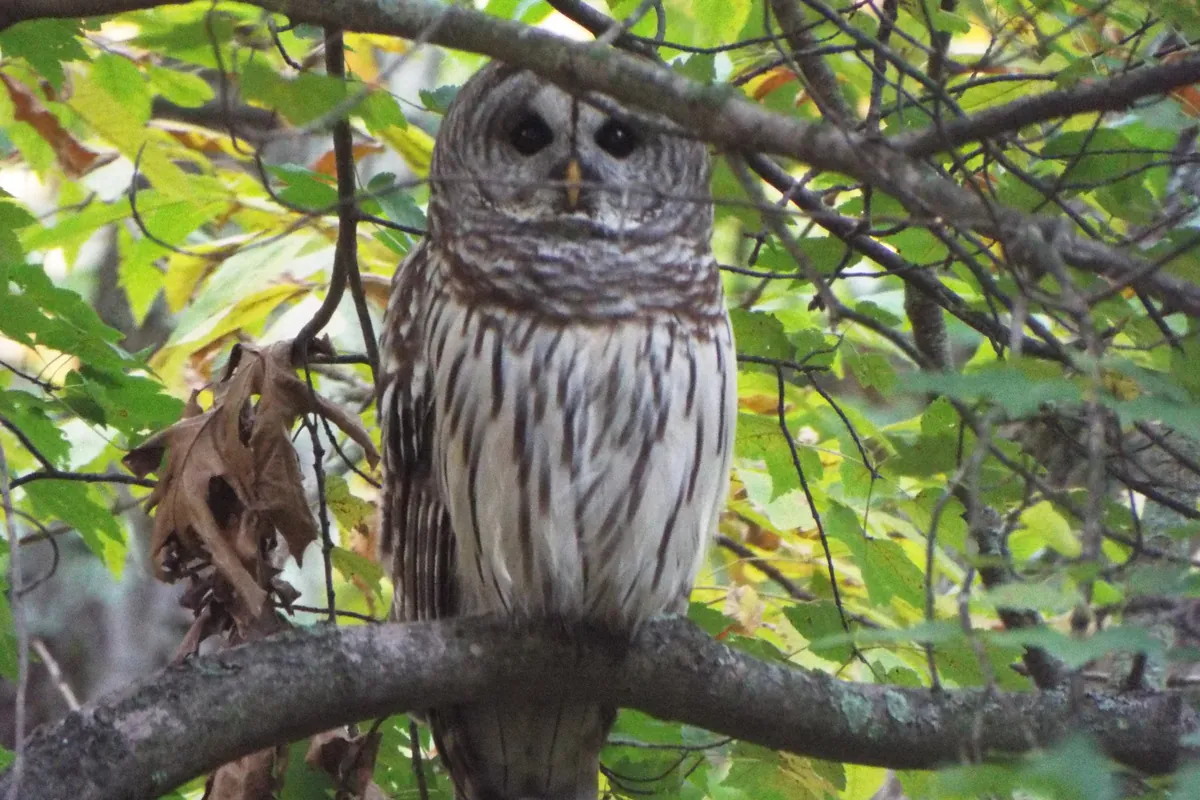
What you're hearing
When
Barred owls call all year, mostly from dusk through the night and again before dawn. They are also one of the owls most likely to call in daylight, especially on overcast days.
Calling picks up in late winter and early spring, when pairs court and defend nesting territories. That is when the loud caterwauling duets are most common. In summer, recently fledged young add raspy begging calls as they follow their parents around.
Where
Barred owls live across the eastern United States and southern Canada, and over the past century they have spread west across Canada into the Pacific Northwest and northern California.
They prefer mature forest, especially wet woods, swamps and river bottoms, but they adapt well to older suburbs and parks with big trees. Many people first hear one from a wooded backyard or a creek corridor behind the house.
Why it calls
The classic "who cooks for you" hoot is a territorial song. Both males and females give it to announce that a territory is occupied, and neighbors often answer each other.
The caterwauling is usually a mated pair calling back and forth: a jumble of hoots, cackles, whoops and gurgles. It is most frequent during courtship. Young owls out of the nest give a hissing or screechy begging call to tell their parents where they are. See all owl calls compared on the owl sounds page.
Barred owl facts
- Size
- 17-20 in. long with a wingspan of about 3.5 ft. Barred Owl (Missouri Department of Conservation)
- Weight
- About 1.3 lb.; females are larger than males. Barred Owl (Tennessee Wildlife Resources Agency)
- Lifespan
- The oldest known wild barred owl was 18 years, 3 months old. Barred Owl (Tennessee Wildlife Resources Agency)
- Diet
- Mice and other small rodents, rabbits, frogs, snakes, insects, crayfish and sometimes fish. Barred Owl (Missouri Department of Conservation)
- Active
- Hunts at night, but often active and calling during the day too. Barred Owl (Missouri Department of Conservation)
- Calls peak
- Heard year-round; duetting pairs are heard most during courtship, which begins in February. Barred Owls: 'Tis the mating season (U.S. Fish and Wildlife Service)
- Habitat
- Forests, especially bottomland woods and wooded swamps; also suburbs with remaining woodland. Barred Owl (Tennessee Wildlife Resources Agency)
- Conservation status
- Least Concern (IUCN Red List, 2024) Strix varia, Barred Owl (IUCN Red List)
Where it lives: Found in all of the Northeast; all of the Mid-Atlantic and Southeast; most of the Midwest (not North Dakota, South Dakota); most of the Southwest and southern Plains (not New Mexico, Arizona); most of the Mountain West (not Colorado, Utah, Nevada); all of the Pacific Coast.
Year-roundSounds like… but isn't
- Great horned owl: A great horned owl gives a deeper, softer run of four or five hoots with no "who cooks for you" rhythm and no cackling.
- Coyote: Coyote groups yip and howl in rising, wavering notes; barred owl caterwauling mixes hoots and cackles and usually comes from high in the trees.
- Common loon: A loon's wail is one long, smooth, rising note over water, while a barred owl's calls are broken into distinct hoots and whoops.
Which owl is that? Compare all four owls →
Should I worry?
The calls themselves are harmless. A barred owl hooting or caterwauling near your house is just defending its territory or talking to its mate.
Owls can be protective near a nest. Attacks on people are uncommon, but owls may swoop at people near nests or young, mostly in spring and fall and at night, dusk or early morning. If one swoops at you, wave your arms, protect your head and face, and leave the area. North Carolina's wildlife agency suggests avoiding the spot for a few weeks (or about a day if owlets are out of the nest), and wearing a bike helmet or carrying an open umbrella if you must pass through.
Free-roaming chickens and ducks are more vulnerable than most pets. Keep poultry in a secure coop with a covered run.
Barred owls are protected by federal and state law, including the Migratory Bird Treaty Act, so they may not be harmed, harassed or captured. Owlets on the ground are often still being cared for by their parents and should be left alone unless clearly injured. If you find an injured owl, contact a licensed wildlife rehabilitator or your state wildlife agency.
Sources: Living with wildlife: Owls (Washington Department of Fish & Wildlife); Barred Owl (North Carolina Wildlife Resources Commission); Migratory Bird Treaty Act of 1918 (U.S. Fish & Wildlife Service).
Questions people ask
What does a barred owl sound like?
Its best-known call is a rhythmic series of hoots usually written as "who cooks for you, who cooks for you-all," ending in a drawn-out note. Pairs also give loud caterwauling duets full of cackles, whoops and gurgles.
What animal sounds like monkeys in the woods at night?
In most of the eastern US, the answer is usually a pair of barred owls caterwauling. The chaotic cackling and whooping is a courtship and territorial duet, most common in late winter and spring.
What does it mean when you hear an owl hooting at night?
It means an owl is nearby and is announcing its territory or keeping in touch with its mate. Hooting is normal behavior and carries no other meaning. Hearing it often just means your area has enough trees and prey to support owls.
Why is a barred owl hooting during the day?
Barred owls are mostly active at night, but they call in daylight more often than most owls, especially on cloudy days or when another owl or a predator is nearby.
Are barred owls dangerous?
Not usually. They may swoop at people near a nest or young, mostly in nesting season, and can knock off a hat. Avoiding the area for a while solves most problems. They are protected by federal law, so do not try to harm or trap them.
How big is a barred owl?
Barred owls are 17 to 20 inches long with a wingspan of about 3.5 feet (Missouri Department of Conservation), and weigh only about 1.3 pounds; females are bigger than males.
How long do barred owls live?
The oldest barred owl known from the wild lived 18 years and 3 months (Tennessee Wildlife Resources Agency).
Please don't play these recordings at wild animals, especially in parks: it can stress them, and many parks prohibit it.